Complete Production Process of MVA Genuine Leather Bags | 12 Dark Secrets Behind Your Wholesale Order – What Factory Don’t Want You to Know
Table of Contents
Introduction
Let’s be honest – finding a reliable genuine leather bag factory is not easy. You’ve probably dealt with suppliers who promise high quality but deliver uneven stitching, wrong leather, or late shipments. Some stop answering your messages after you pay the deposit. Others send samples that look nothing like the bulk order.
At MVA, we want to do things differently. We’re a leather bag manufacturer based in Guangzhou’s Baiyun District, and we believe in keeping things transparent – no hidden processes, no shortcuts, no surprises. In this post, I’ll walk you through our entire 12-step production process, from the first design chat to the final carton sealing.
By the end, you’ll know exactly how we work, where we pay extra attention, and why our clients (including some who’ve stayed with us for over six years) trust us with their wholesale orders.
And if you have a project in mind? Just send us your sketches or reference photos – we’ll get back to you within 24 hours with a free sample and a clear quote.
Why Bother Understanding How Bags Are Made?
You might think: “I just need a supplier, not a manufacturing degree.” But here’s the truth – every step in leather bag production affects the next. One small mistake in pattern making can ruin an entire batch. Knowing the process helps you:
- Avoid common traps – When you know what to check (like ±2mm pattern tolerance or 3-layer edge painting), you won’t accept poor workmanship.
- Plan your inventory – Sampling takes 7–12 working days; bulk production about 20 days. Now you can schedule your launches without panic.
- Spend wisely – Some steps (like skiving and edge finishing) are non-negotiable. Others can be optimized to save cost without hurting quality. We’ll show you where.
Step 1 – Custom Bag Design (One-on-One with Real People)
You won’t talk to a robot or a salesperson who just forwards emails. Melody and Cecile – our senior account managers – will work with you directly.
We’ll go over:
- Your target market and price range
- Bag style and silhouette (firm and structured? soft and slouchy?)
- Functional needs: anti-theft zippers, waterproof coating, RFID pocket – whatever your customers want
Once we understand your vision, we lock down the leather grade, thickness, hardware type, and all specs. You can send us hand-drawn sketches, photos of a bag you like, or just describe it in your own words. Nothing is set in stone until you say “go.”
We’ve been working with a Russian client for six years now – they send us a napkin sketch sometimes, and we turn it into a production-ready bag. No complaints so far.
Step 2 – Pattern Making (The Blueprint)
This is where design becomes reality – and it takes serious skill. Our pattern makers convert your approved design into a full tech pack, then cut 1:1 paper templates for every single piece.
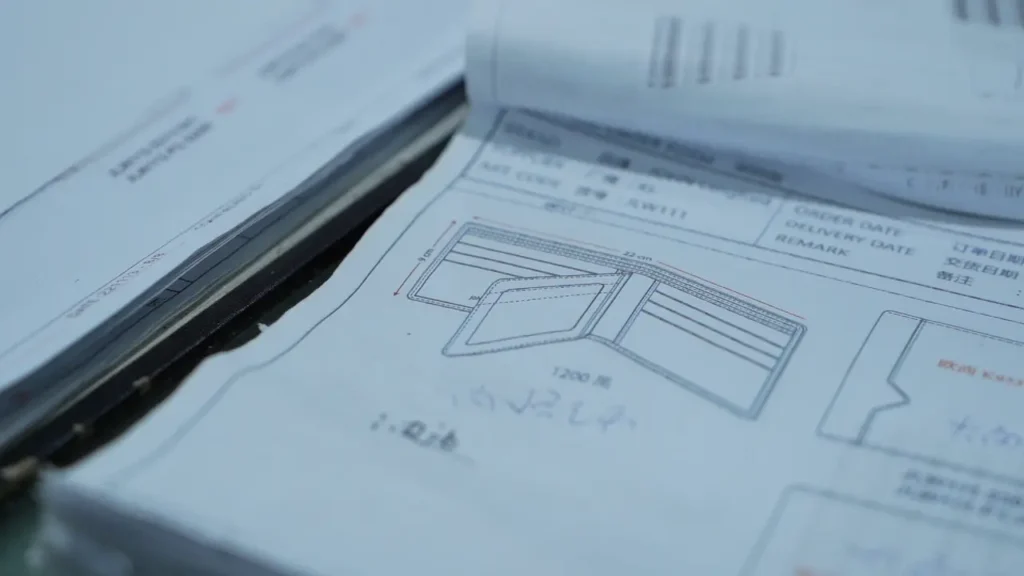
A typical women’s handbag needs 25 to 30 separate paper patterns. Think about that – each curve, each pocket, each strap has its own shape. If the pattern is off by even a couple of millimeters, the whole bag won’t assemble correctly.
We control pattern tolerance within ±2mm. Every notch, stitch line, and alignment mark is triple-checked against your design. This might sound picky, but it’s the only way to make sure your bulk order looks exactly like the sample.
Step 3 – Sample Making (Show, Don’t Just Tell)
We make three types of samples:
- First prototype – just to check shape and structure
- Sales sample – finished with correct leather and hardware
- Pre-production sample (PP sample) – the final version before mass production
Sampling usually takes 7 to 12 working days, depending on complexity. Once you approve the PP sample, that becomes our golden standard. We will never start bulk production without your green light – period.
After you say yes to the sample, you can place your wholesale order with confidence.
Step 4 – Sourcing Leather & Hardware
Now we buy the actual materials – strictly based on the approved PP sample. No substitutions, no “similar enough.”
For standard bags, we use genuine cowhide around 1.1–1.3mm thick. For oil-wax leather styles, the raw hide is thicker. We also offer two cooperation models: OEM (you provide some materials) or CM (we handle everything).
Material preparation takes 1 to 3 working days. And as soon as the leather arrives, our team sorts it by natural color and grain – because even from the same batch, no two hides are identical. This step prevents ugly color differences or mismatched textures on your finished bags.
Step 5 – Cutting (Where Waste Is Controlled)
Using punching machines and custom steel cutting dies, we cut the leather and lining into all the small pieces that will become your bag.
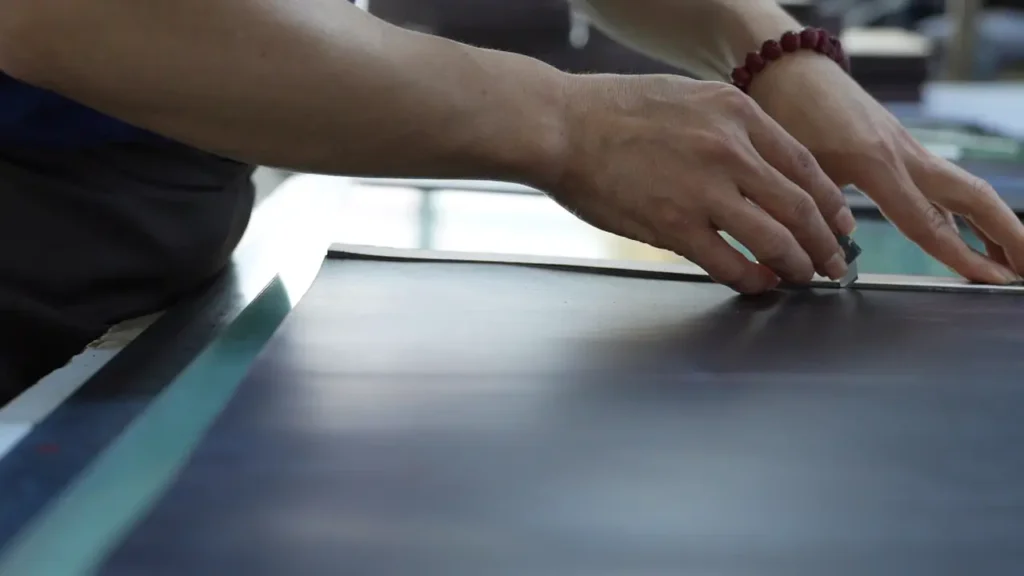
Our senior cutters always follow the natural grain direction – that keeps the texture and color consistent across a single bag. They also plan the layout carefully to maximize leather yield. High-grade leather goes to visible parts (front panel, flap). Slightly less perfect areas get used for inner pockets or hidden spots. That way you get a beautiful bag without paying for wasted material.
Machine cutting means every piece is identical. And we check each cut edge – no rough burrs, no uneven shapes.
Step 6 – Skiving (Making Leather Thin Where It Needs to Be)
Raw cowhide is about 2–3mm thick. If you sew two thick edges together, you get a bulky, ugly seam. That’s why we skive – we thin down specific areas using large splitting machines and smaller precision skivers.
For edges that will be folded or glued, we take them down to 1.0–1.2mm. This makes the joint smooth and almost invisible.
Skiving is one of those steps you never see, but you feel it – in the comfort of the handle, the sleekness of the edge, the way the bag holds its shape. We check every skived piece to avoid over-thinning (which weakens the leather) or under-thinning (which leaves bulky seams).
Step 7 – Table Work (The Slow, Meticulous Part)
This is the most time-consuming manual step. Workers mark exactly where handles, hardware, and pockets will go. Then they apply glue, fold edges, shape the pieces, install metal fittings, and emboss your logo using professional embossing machines.
After all that, the semi-finished parts go to the stitching workshop.
We inspect every piece at this stage – no overflow glue, no wrinkled folds, no crooked hardware, no blurry logos. If it doesn’t look right, it doesn’t move forward.
Step 8 – Stitching (Where Strength Meets Beauty)
Our workshop has both ordinary sewing machines and high-precision computerized ones. Computerized machines keep stitch spacing perfectly uniform across hundreds of bags – something even the best human can’t do consistently.
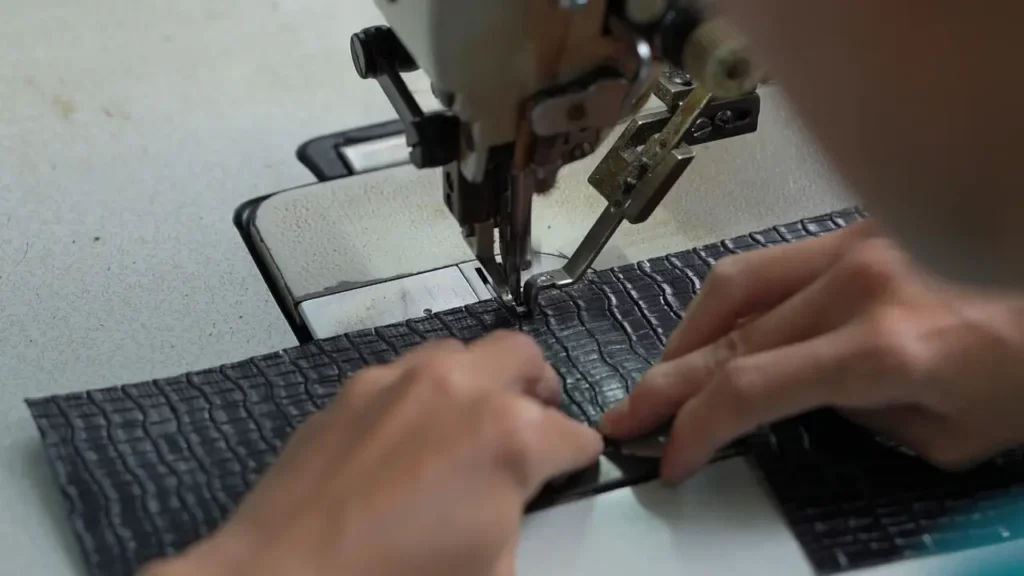
Stitching isn’t just about looks (though straight, even stitches do look great). It’s about durability. We use backstitch reinforcement on high-stress areas – bag handles, shoulder straps, zipper ends – so your bags last longer.
We reject any work with skipped stitches, broken threads, or uneven lines. Period.
Step 9 – Edge Painting (The Mark of a Premium Bag)
You can judge a leather bag’s quality by looking at its edges. Rough, cracked, or peeling edges are the first sign of a cheap product.
We use original Italian FENICE edge paint as our standard. We also offer eco-friendly water-based edge oil from France upon request.
Each edge gets three coats. Between each coat, we let it dry completely, then sand it smooth. No rushing. This is why our edges stay glossy and intact for years.
When you run your finger along the edge of an MVA bag, it should feel smooth – no bumps, no sticky spots, no rough patches.
Step 10 – Strict Quality Control (MVA Factory Team Check, Then Check Again)
We don’t rely on one person’s eyes. Our QC system has three layers:
- Self-inspection – each worker checks their own work
- Cross-inspection – the next production station checks the previous one
- Independent QC – a dedicated team, separate from production, inspects every single bag against the approved PP sample
After bulk production finishes, we do AQL 2.5 sampling inspection and run every bag through a needle detector (yes, broken needles happen, and we find them).
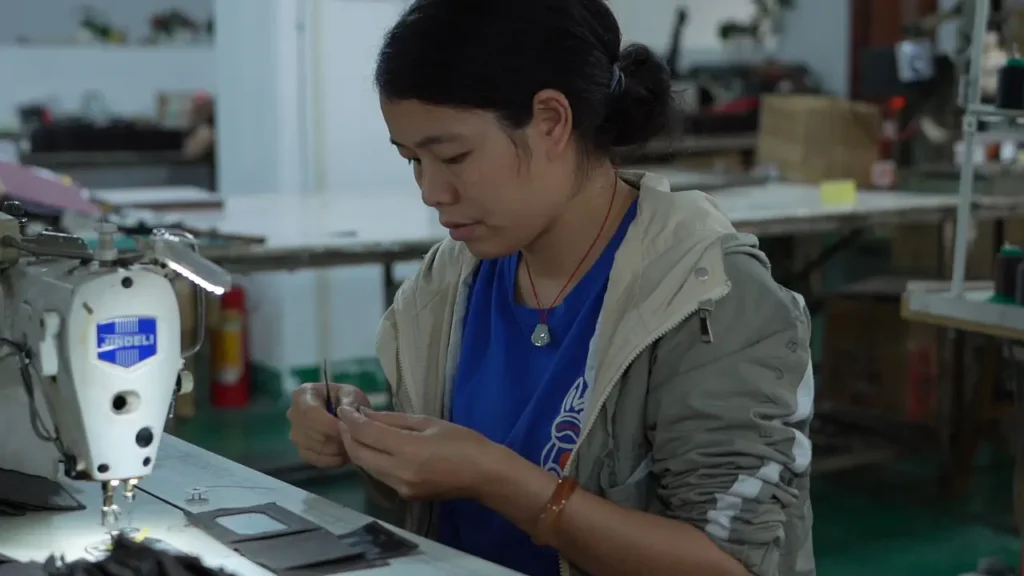
If a bag fails any check, it’s either repaired or rejected. We can also host your own third-party inspection or provide a detailed QC report. Whatever builds your trust.
Step 11 – Cleaning & Finishing (Ready for the Customer)
Before packing, each bag goes through final cleaning:
- Trim loose threads
- Wipe off dust, glue residue, stains
- Fill with shaping paper and soft filler to keep the silhouette perfect during shipping
This step might seem small, but it directly affects your customer’s unboxing experience. A clean, well-shaped bag inside a nice box feels premium. A dusty bag with wrinkled lining feels cheap. We take it seriously.
Step 12 – Packaging & Shipping
Each bag gets an individual dust bag, then shaping filler, then a moisture-proof bag, and finally a thick export carton.
Before sealing the cartons, we randomly inspect 20% of the order and record a packaging video for you. You can see exactly what’s being shipped – no guesswork.
We also support custom packaging: gift boxes, printed labels with your branding, barcodes, even custom carton markings. Just tell us what you need.
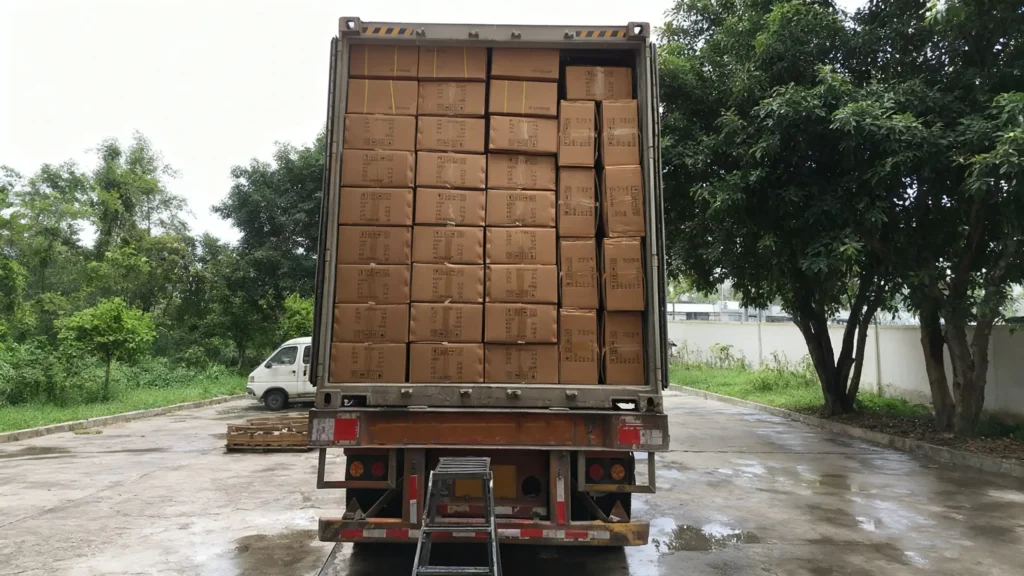
Once you confirm the shipment schedule, we prepare all customs documents: packing list, commercial invoice, customs declaration. We’ve shipped to dozens of countries – the paperwork won’t be a problem.
B2B Wholesale FAQ (Real Questions from Real Buyers)
For regular styles, 50 pieces per color. For complex designs or special leather, it might be higher – but we can talk. We’re flexible with new partners.
Sampling: 7–12 working days. Bulk production: about 20 working days after sample approval. Total around 25–30 working days.
Absolutely. Logo embossing, hot stamping, metal nameplates, size changes, color matching, custom boxes – OEM and ODM both welcome.
Three-layer inspection + AQL 2.5 + needle detection. We can send you a QC report or invite a third-party inspector.
We charge a reasonable fee based on labor and leather. It’s fully refundable after you place a bulk order.
Yes – photos, hand-drawn sketches, or even an actual sample bag. Our pattern makers will replicate or improve it.
Top-grain cowhide, crazy horse, tumbled leather, nappa. We can adjust thickness and softness to your needs.
Small tweaks (softness, internal pocket layout, strap length) – free. Major revisions might cost a small fee, but we’ll tell you upfront.
Natural leather has minor variation in grain and shade – that’s part of its beauty. We use the same batch to minimize differences, and the silhouette will be identical.
Yes, we offer volume discounts. Long-term partners get fixed wholesale prices.
Yes – RFID pockets, anti-theft zippers, reinforced straps, waterproof coating. Just ask.
Before cutting starts – free. After cutting – you cover the material cost already used.
Yes, we keep popular styles in stock year-round. You can mix and match models for wholesale.
30% deposit to start production, 70% balance after you inspect (or we send inspection proof).
Yes. Pure copper, anti-rust coating, custom finishes – we can source what you need.
Manufacturing defects – free repair or replacement. Normal wear and tear or customer damage – not covered. For large orders, we can write a custom agreement.
Ready to Start Your Bag Project?
If you’ve read this far, you already care about quality – and that’s exactly the kind of partner we’re looking for.
Send us your sketches, reference photos, or just tell us what you need. We’ll reply within 24 hours with a free sample offer and a clear, no-pressure quote.
Contact Melody or Cecile directly on WhatsApp: +86 18925073489
Or use the contact form below. Let’s make something good together.