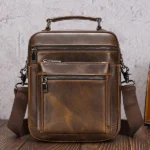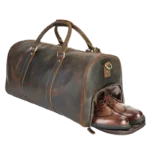
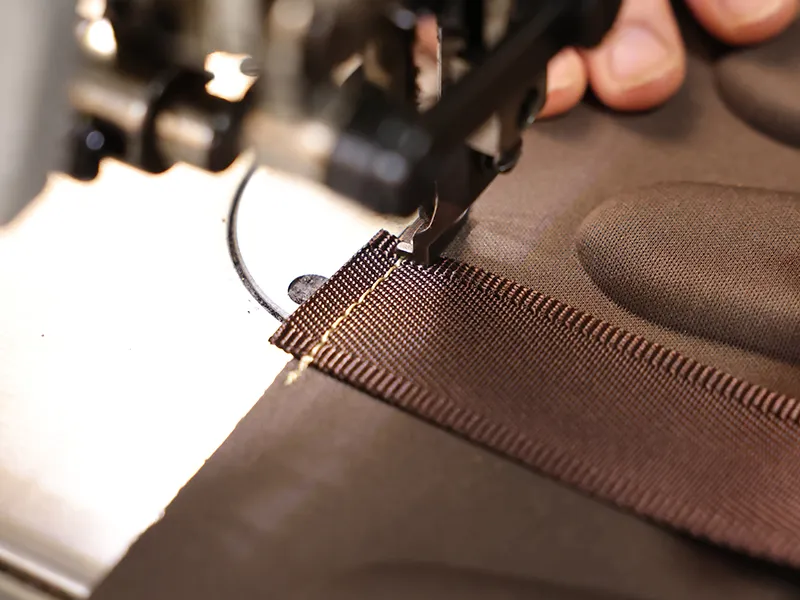
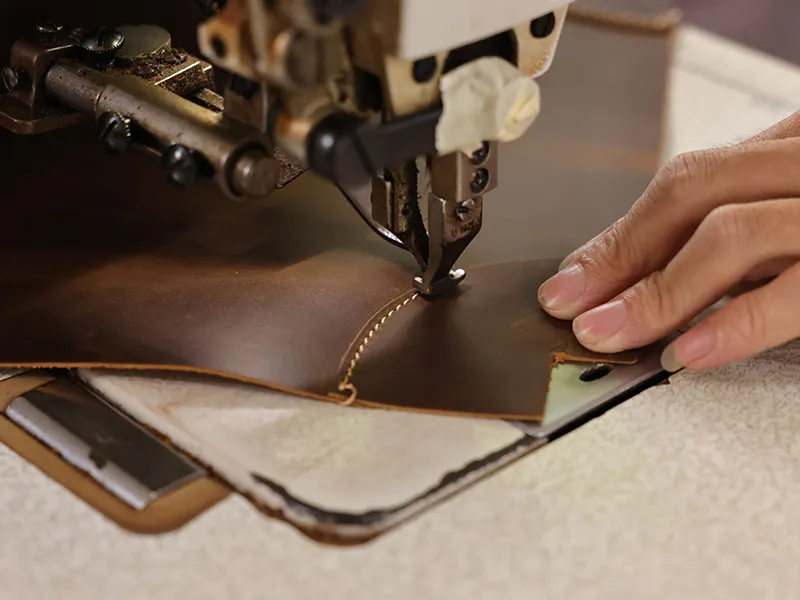
Direct answer: A professional leather travel bag manufacturer builds a durable duffel by engineering three things most buyers never inspect — the handle anchoring system (boxed X-stitching into a leather patch, never straight into the panel), full-panel hide matching for large bags, and corner-tested long zippers. At Marrant Leather Goods, every wholesale leather travel bag order passes a 25kg static load test on handles and D-rings before it ships. Everything below explains how, and what to demand from your leather duffel bag manufacturer.
Now — here’s what nobody in the industry tells you. Two bags can use identical full-grain leather, and one falls apart in fourteen months while the other outlives its owner. The difference isn’t the hide. It’s what’s happening four centimeters inside the seams.
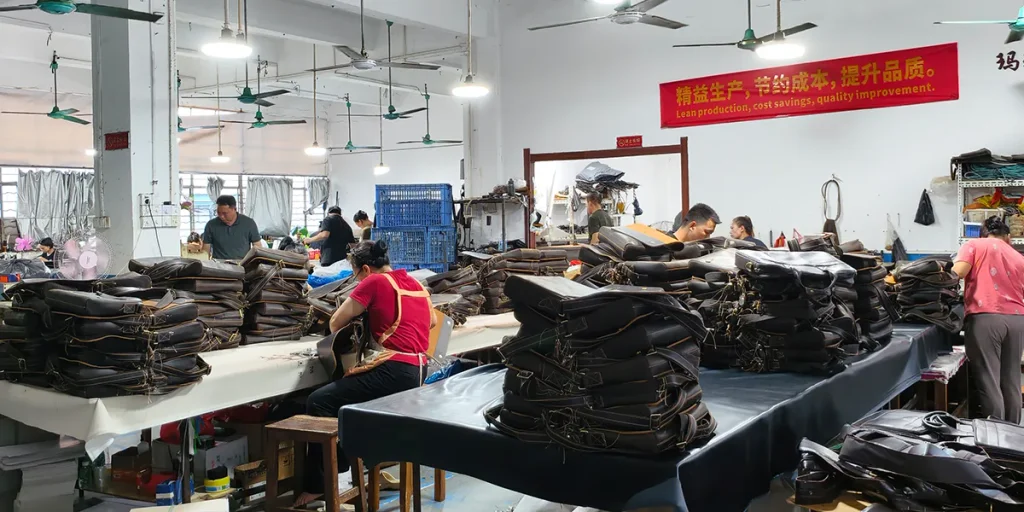
1. Handle & Shoulder Strap: The Stress Architecture Nobody Sees
Carry a loaded weekender through an airport once and roughly 18–22kg pulls on two small stitch zones. That’s brutal.
Here’s how factories solve it:
| Component | Cheap Construction | Factory-Grade Construction |
|---|---|---|
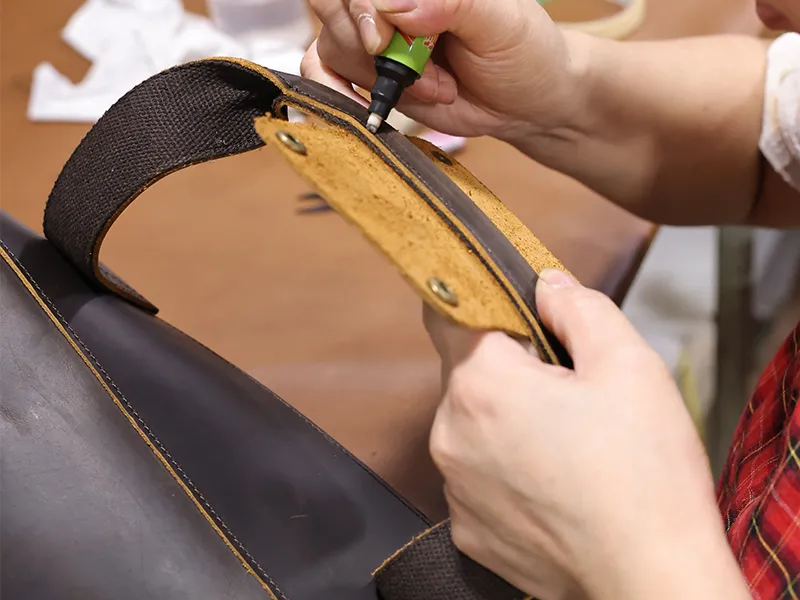
| Handle base | Stitched directly to outer panel | Hidden leather patch + rivets + boxed X-stitch |
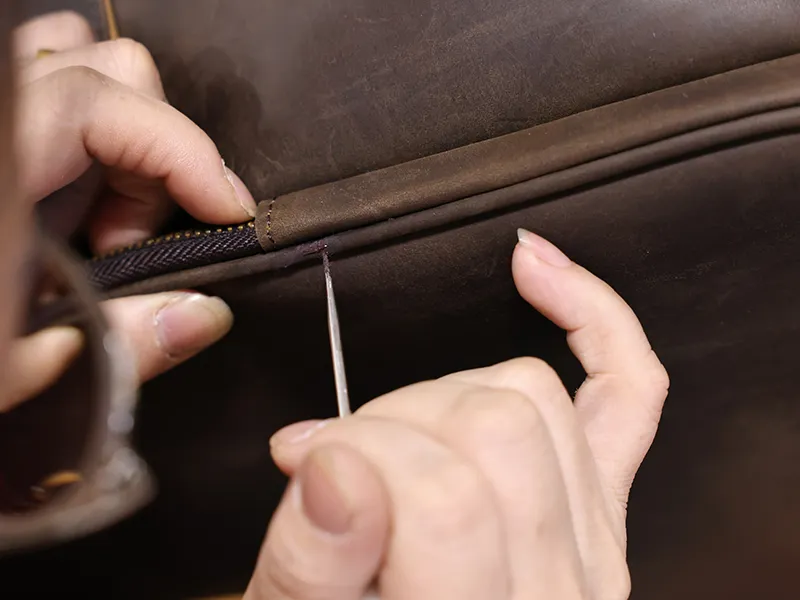
| Stitch type | Single lockstitch | Saddle stitch (two needles, self-locking) |
| Thread | Polyester #40 | Waxed polyester #20 or linen |
| D-ring anchoring | Single tab | Double-layered tab, bartacked ×4 |
The boxed X pattern isn’t decoration. It distributes diagonal pull across a 6×6cm zone instead of a 2cm stitch line. Marrant’s custom leather weekender bags spec this as standard — because handle failure is the #1 warranty claim in this category, industry-wide.
2. Matching Color & Grain Across Large Panels
A weekender needs roughly 0.9–1.2 m² of usable hide. No single cow offers uniform grain across that area — the belly is looser, the back is tighter.
So what do we do? Skins are split into “couples” at the cutting table: the front panel and its adjacent side panel come from the same quadrant of the same hide. For bulk orders, our leather travel bag OEM workflow batches hides by dye lot number, then a senior cutter (not a machine) makes the final pairing call on every set of five panels.
Skip this step and the bag looks fine in photos… until daylight hits it. Ever seen a duffel where one side looks slightly “flatter”? That’s a mixed-lot cut.
3. Bottom Board, Side Walls & Mouth Reinforcement
Drop a 20kg bag off a luggage rack and the floor panel takes the entire impact. Our spec:
- Bottom: 3mm compressed leather board or HDPE sheet wrapped in leather, stitched (not glued) into a boxed corner
- Side walls: 1.5mm leather board “skeleton” that lets the bag stand empty — a small detail your retail customers notice immediately
- Bag mouth: extra 2cm reinforcement band around the opening, because this is where zippers tear out under overstuffing
4. Long Zippers at Corners: Where Smoothness Is Won or Lost
A #10 YKK-style zipper on a curved corner is a physics problem — the tape wants to kink at a 35–45° bend.
The fix is a three-part system: molded plastic teeth (they flex, metal doesn’t), a zipper tape that’s pre-curved and rested 24 hours after sewing, and a stop box positioned 3cm past the curve’s apex. Every prototype we build gets cycled 500 times open-shut before approval. A zipper that sticks at the corner on day one will fail by month six. Why would anyone ship that?
5. Empty Weight vs. Real Capacity: The Numbers Buyers Actually Ask For
For wholesale leather travel bags sold online, listing only “45L” causes returns. We publish both numbers:
| Size | Empty Weight (full-grain) | True Usable Capacity | 3-Day Trip? |
|---|---|---|---|
| Weekender 45cm | 2.1–2.4 kg | 38–40L | ✔ |
| Cabin duffel 50cm | 2.5–2.8 kg | 45–48L | ✔ |
| Large 55cm | 2.9–3.3 kg | 55–58L | ✔✔ |
Rule of thumb we give every buyer: a full-grain leather duffel under 1.8kg at 45cm is either thin leather or a fabric-lined hybrid. Don’t let the spec sheet hide that from you.
6. Detachable Strap & D-Rings: Load Ratings, Not Promises
A detachable shoulder strap is a liability if the hardware is under-spec’d. Our standard: 25mm-wide cast solid-brass D-rings rated to 40kg each, paired with a strap pad that has an internal anti-slip silicone layer. The swivel hooks must be forged, not stamped wire — stamped hooks open under sustained diagonal load. It’s a 30-cent part difference on a $90 bag. And it’s exactly where cheap production quietly saves money.
7. Where Travel Actually Wears a Bag (Field Data)
We tracked returns and repair photos across three seasons of OEM production. The top wear points:
- Handle bases — friction against the hip when carried short
- Bottom corners — airport conveyor abrasion
- Zipper ends — overstuffing stress
- Shoulder pad underside — sweat + dye transfer onto light clothing
- Feet rivets — dragging up stairs
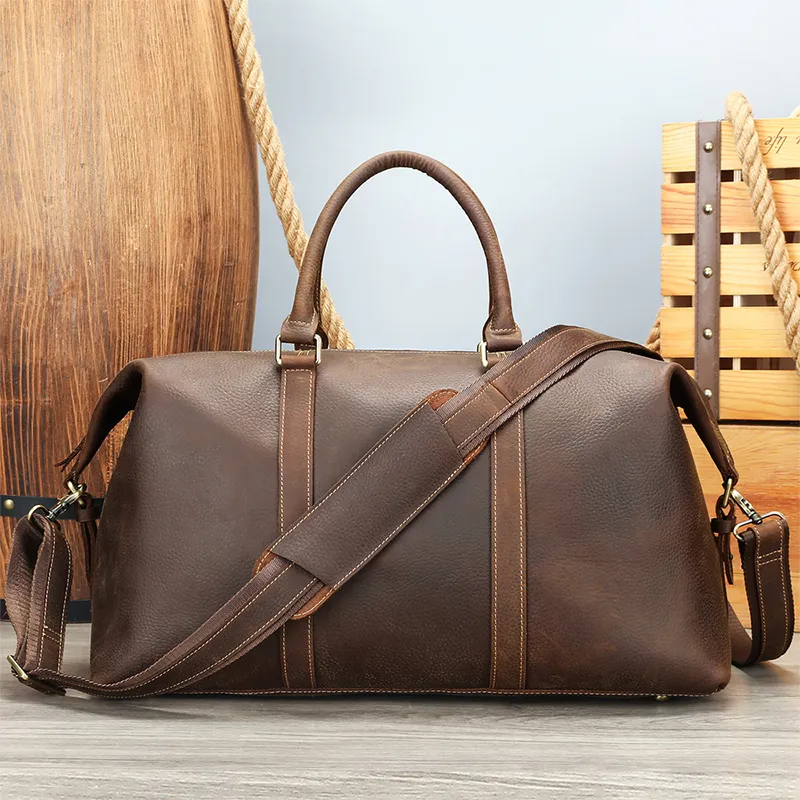
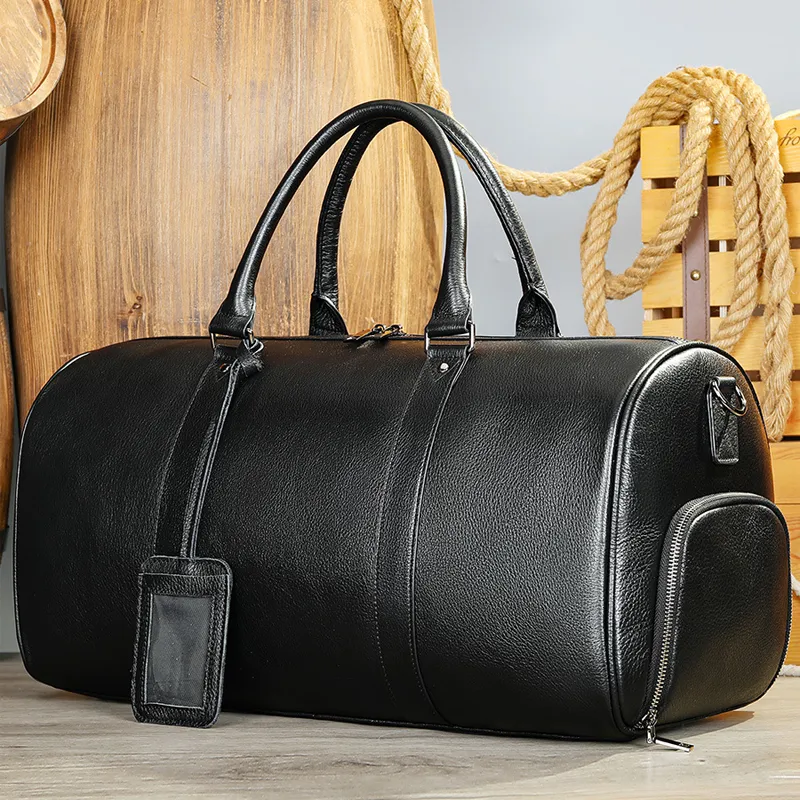
A quick note on styling: if your line skews toward open-top carry silhouettes for shorter trips, our travel tote bag collection uses the same reinforcement logic in a lighter build — worth a look for range extension.
A Buyer Story, Because Specs Only Tell Half of It
Last spring, a boutique buyer from Copenhagen ordered 300 cabin duffels from us — their previous supplier’s handles had failed on 11 bags within the first quarter. We rebuilt their spec with double-tab D-rings and waxed thread. Eighteen months later: zero handle claims. Their re-order this year came in at 600 units, in three new colors, with hide-matching photos approved panel by panel before cutting. That’s the wholesale relationship in one paragraph — trust is earned in the stitching details.
Packaging: How We Prevent Crushing Deformity in Bulk Shipping
This part gets ignored until a container arrives and the top layer of bags is creased. For OEM orders, Marrant ships each duffel:
- Stuffed with air paper pillows (never newspaper — ink transfer)
- With the base board wrapped separately in felt to prevent edge imprinting
- Inside a non-woven dust bag, then a corrugated box — never vacuum-compressed
- Palletized with A-frame racks so no bag carries stacking weight on its mouth
Vacuum packing saves 30% container space and costs you a season of returns. Bad trade.
Sample Load Test & Approval Standards (Our Internal Spec)
Every pre-production sample must pass this gate before bulk cutting begins:
| Test | Method | Pass Standard |
|---|---|---|
| Static handle load | 25kg suspended, 24 hrs | No seam creep >2mm |
| Drop test | 1m drop, fully loaded ×3 | No hardware failure |
| Zipper cycle | 500 open/close, corner focus | No jam, no tape separation |
| Strap fatigue | 15kg oscillation ×5,000 cycles | No stitch breakage |
| Color rub | White cloth, 20 N pressure ×10 | No visible transfer |
We send the pass/fail report — with photos — with every sample. Ask for it. Any leather travel bag manufacturer worth the name will have one.
Frequently Asked Questions
Q1: What MOQ should I expect from a leather travel bag manufacturer for custom designs?
True custom builds (private hardware, new pattern) typically start at 100–300 units per color industry-wide. Marrant Leather Goods runs OEM programs from just 50 units per style — we believe you should test the market before you commit a container to it. For existing styles with logo or color changes, we can go even lower on pilot runs.
Q2: How do you guarantee color consistency across a bulk leather order?
Three controls: hides dyed in a single lot, panel-matching from the same hide quadrant, and a signed “golden sample” under D65 daylight lighting kept on file. Every production batch is compared against it before packing — not after.
Q3: Full-grain vs. top-grain for wholesale duffels — which should I choose?
Full-grain for premium positioning ($150+ retail): it ages visibly and drives repeat brand loyalty. Top-grain for volume lines: more uniform, 15–20% cheaper, easier color matching across large panels. There’s no wrong answer — only a wrong price point for the leather you chose.
Conclusion
Strip away the marketing, and a durable duffel comes down to nine factory decisions. Save this list — it’s the same one our own QC team uses:
✅ Handles: boxed X-stitch into a hidden leather patch, saddle stitch, waxed thread
✅ Hide matching: panels cut from the same hide quadrant, same dye lot
✅ Bottom: 3mm board, stitched boxed corners, never glued
✅ Zipper: molded teeth, pre-curved tape, 500-cycle corner test
✅ Weight honesty: publish both empty weight and true capacity
✅ Hardware: forged D-rings rated 40kg+, never stamped wire
✅ Wear mapping: reinforce the five real failure points (handles, bottom corners, zipper ends, strap pad, feet)
✅ Packing: stuffed, boxed, A-frame pallets — no vacuum compression
✅ Approval gate: 25kg static load + drop test documented in writing before bulk production
Ask any leather travel bag manufacturer to show you all nine. The ones who answer quickly and with photos — those are the ones worth your wholesale budget. The ones who go quiet? You already have your answer.
At Marrant Leather Goods, we put this checklist in writing with every OEM sample, starting at 50 units per style. Because a bag that survives the factory load test is the only kind worth putting your brand name on.