


With the lifting of pandemic restrictions, China’s foreign trade market is making a strong comeback. Although the tariff war initiated by Trump in early 2025 put many foreign trade businesses under great pressure, China launched a series of foreign trade policies centered on stable growth, innovation promotion, and service optimization in the middle of 2025. Covering key areas such as accelerated tax refunds, cross-border e-commerce empowerment, customs clearance facilitation, financial support, and new business format development, the core preferential measures include:
Jointly launched by 20 government departments, 29 measures span goods trade, digital trade, green trade, and other fields. These measures streamline the AEO enterprise certification process, expand the list of beneficiary enterprises, and provide incentives such as low inspection rates and priority customs clearance.
As revealed to us by Alibaba product managers in 2025, Alibaba has rapidly expanded its foreign trade strategy. For example, it dispatched over 30 personnel for on-the-ground promotion in Ho Chi Minh City, Vietnam, vigorously supporting domestic businesses in connecting with small, medium, and large merchants across Southeast Asia. Yu Yong, former CEO of Alibaba and current CEO of 1688, is committed to transforming 1688 into a global B2B international trade platform. In mid-January 2026, the platform will launch multi-language translation for product pages and multi-currency settlement functions, significantly enhancing the convenience of Chinese merchants’ product exports.
According to the luggage industry report released by Alibaba, the global luggage market exceeded 200 billion USD in 2025. Among all luggage categories:
The wallet market is a promising blue ocean with overall supply falling short of demand. Key buyer countries include the United States, Pakistan, and the United Kingdom, with genuine leather card holders, wallets, and hollow-out wallets being the core focused products. While women’s bags and handbags remain the dominant categories in terms of business opportunities, luggage, travel bags, backpacks, wallets, and crossbody bags are also high-potential segments not to be ignored.
With the rise of Generation Z, consumer trends such as technological texture, outdoor sports popularity, and environmental sustainability have become increasingly prominent. In addition to conventional product names, surging search terms include personalized customization keywords such as “wholesale bags” and “custom bags,” reflecting the growing demand for customization.
Focusing on product details, the popular functions of luggage mainly concentrate on the following: RFID anti-theft, waterproof, USB-enabled, anti-theft, environmental friendliness, and fashion. For customized luggage products, buyers have clear requirements for styles and functions but are relatively flexible in material selection. They expect suppliers to recommend fabrics that better meet functional needs or offer higher cost-effectiveness.
In addition, Marrant’s new product innovation capability continues to strengthen, with monthly new product launches. Many long-term clients have reported positive market feedback after trying the new products, which greatly encourages Marrant to further invest in innovation and provide customers with higher-quality and more innovative leather products.
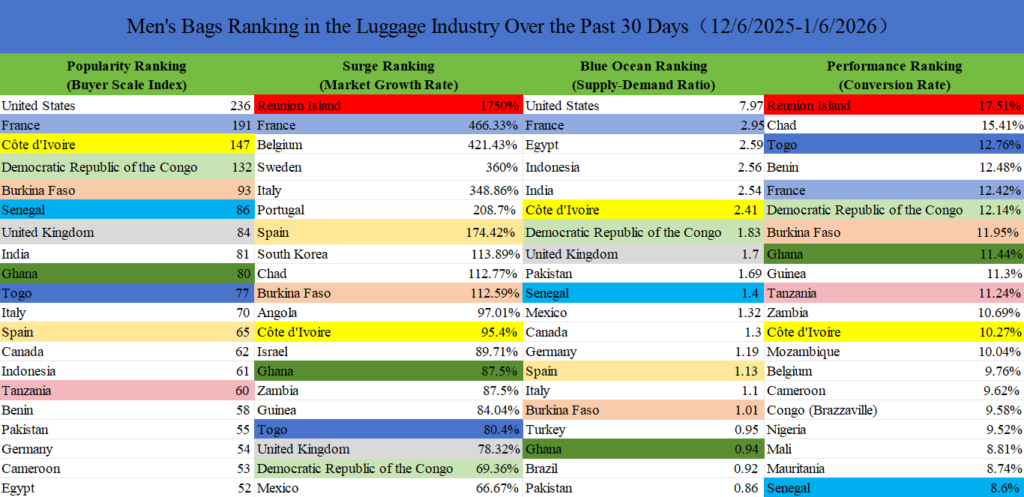
Data Source: Alibaba.com Men’s Bags Ranking (December 6, 2025 – January 6, 2026)
Over the past year, the leather and luggage industry has experienced rapid development. Amid this fierce “silent competition,” Marrant has maintained steady progress, excelling in its eight core product categories: briefcases, backpacks, travel bags, wallets, crossbody bags, chest/waist bags, card holders, and women’s bags. Serving merchants from more than a dozen countries, Marrant implements a 3-step quality inspection process for each product. Its superior warehousing capacity and fast response delivery speed have achieved a customer satisfaction rate of 99.6%. In 2025, Marrant’s annual performance increased by 17% compared to 2024, delivering impressive results in the year-end summary.



Get notified about new articles
Just write down some details and our staff will contact you quickly!