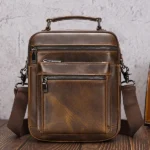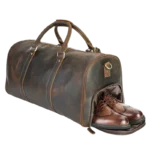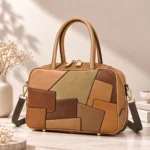
The expected genuine leather bag lifespan is often expressed as a simple number of years. In practice, service life is controlled by a system: leather fibre structure, surface finish, panel thickness, reinforcement, thread, seam design, hardware, edge treatment, user load, climate, and maintenance. A premium hide cannot compensate for a weak handle attachment, while a well-engineered bag made from corrected-grain leather may outlast a poorly constructed full-grain product.

This buyer-oriented report explains how different leather materials and manufacturing processes compare under realistic use. It also sets out a practical factory testing and shipment inspection framework for brands, wholesalers, and importers.
One limitation must be clear from the start: laboratory cycles do not convert directly into calendar years. A flex test isolates repeated bending; a rub test measures surface behaviour; a whole-bag load test challenges the assembled product. None reproduces every combination of sunlight, rain, sweat, overloading, storage, and care. The lifespan ranges below are therefore planning estimates for moderate consumer use, not warranties or published universal standards.
Executive Test Findings
For a bag used three to five days per week, carried within its designed load, stored dry, and cleaned appropriately, the following ranges are reasonable for product planning. Actual results can fall outside them.
| Material or construction | Indicative service-life potential | Typical strength | Primary life-limiting risk |
|---|---|---|---|
| Full-grain cowhide | 7–15+ years | Dense grain layer; can develop an attractive patina | Poor conditioning, water damage, weak seams, or overloaded handles |
| Top-grain or corrected-grain cowhide | 5–10 years | Consistent appearance and useful stain resistance | Finish cracking, peeling, or colour loss before the leather substrate fails |
| Pull-up or “crazy horse” leather | 5–12 years | Wax/oil finish can redistribute light marks | Colour transfer, uneven care, drying, or darkening that conflicts with customer expectations |
| Nubuck or suede | 3–7 years | Flexible hand feel and premium tactile character | Soiling, abrasion, water staining, and difficult cosmetic recovery |
| Pigmented split leather | 2–5 years | Cost-efficient genuine leather construction | Lower tear margin and coating failure at bends or edges |
| Bonded leather composite | 1–3 years | Uniform appearance and low initial cost | Layer separation, cracking, and misleading labelling if composition is unclear |
These categories are not grades on one straight ladder. A heavily coated “top-grain” leather may look uniform but age differently from an aniline full-grain hide. Nubuck may remain structurally sound after its appearance is no longer acceptable for a fashion application. Bonded leather may not qualify for the same “genuine leather” claim in every market. Material identification and destination-market labelling should therefore be confirmed before production.
Test Scope and Evaluation Method
Define the product application first
A lifespan test begins with customer requirements. A small evening bag carrying 0.8 kg should not use the same whole-product protocol as a 15-inch laptop briefcase carrying 5 kg. The specification should state the rated load, expected use frequency, climate, colour-transfer sensitivity, exposure to rain, and acceptable cosmetic ageing.
For comparison, this report assumes an everyday shoulder bag or briefcase used in normal urban conditions. The bag is not repeatedly soaked, left in a hot vehicle, stored against a damp wall, or loaded beyond its stated capacity.
Control the samples
Test units should represent production materials and construction. Record the leather supplier, material code, colour batch, nominal thickness, tanning and finish type, lining, reinforcement, thread, hardware, adhesive, and edge paint. Conditioning before physical testing matters because temperature and humidity affect leather behaviour. Where a standard method is specified, use its required sampling and conditioning rather than testing immediately after unpacking.
Separate material tests from whole-bag tests
Material tests identify risks in the leather or finish. Whole-bag tests reveal interactions among panels, seams, handles, hardware, lining, and reinforcement. Both are necessary. Passing a leather tensile test does not prove that a rivet is correctly positioned; passing a handle load test does not prove that dark leather will not stain a light garment.
Leather Material Tests That Predict Durability

Thickness and consistency
Thickness should be measured across representative areas, not at one convenient point. Variation changes folding behaviour, seam bulk, edge appearance, and tear resistance. The approved range must reflect the pattern: a wallet panel may be split thinner than a load-bearing handle. ISO maintains a method for leather thickness measurement under ISO 2589, while the product specification provides the actual acceptance range.
Tensile and tear behaviour
ISO 3376:2020 specifies measurement of tensile strength and elongation for all leather types. Tear methods assess how a cut or hole propagates under load. These tests are useful for handles, tabs, gussets, and areas around rivets, but results depend on specimen direction and thickness. They should be evaluated with the construction rather than used as a generic marketing number. The related methods can be reviewed in the ISO leather and furs standards catalogue.
Flex resistance
Leather at a flap, gusset, zipper opening, or folded edge bends repeatedly. ISO 5402-1:2022 describes dry or wet flex-resistance testing for flexible leather below 3.0 mm. Inspect at agreed intervals for finish cracking, grain cracking, delamination, or colour change; do not report only the final cycle count.
Dry and wet rubbing
Colour transfer is both a quality and customer-complaint risk, especially for dark or pull-up leather used against light clothing. ISO 11640 evaluates a leather surface under repeated rubbing with wool felt, while ISO 20433:2024 addresses colour transfer using dry and wet rubbing cloths. The latter explicitly includes both dry and wet tests.
Finish adhesion
For pigmented, smooth finished leather, premature coating separation can end the cosmetic life of the bag while the substrate remains intact. ISO 11644:2022 measures adhesion of the finish to leather or between adjacent finish layers. It is not intended for unpigmented aniline, pull-up, suede, nubuck, or other surfaces without a suitable continuous coating, which is why test selection must follow material type.

Whole-Bag Construction Tests
Handle and strap loading
A practical protocol includes static loading and repeated dynamic lifting. As an illustrative buyer specification—not a universal standard—a bag rated for 4 kg might be proof-loaded at 1.5 times the rated load for a defined holding period, followed by repeated lifting at the rated load. Inspect stitching, rivet holes, leather elongation, reinforcement movement, hardware deformation, and seam opening. The load factor, duration, and cycle count must be approved for the product; increasing them arbitrarily can create an unrealistic test.
Seams and stress points
Common early failures occur where handles meet the body, at zipper ends, pocket corners, D-ring tabs, and the base-to-gusset seam. Factory testing should check stitch density, backstitch length, needle damage, thread tension, seam allowance, skiving width, adhesive coverage, and reinforcement position. A beautiful external seam may still fail if the hidden backing is undersized.
Hardware and closures
Zippers, magnetic snaps, buckles, swivel hooks, and plated metal parts often determine usable life. Cycle the closure under the same alignment and tension found in the finished bag. Check zipper tooth damage, slider wear, snap retention, spring action, plating abrasion, and corrosion after the agreed exposure. Hardware specifications should identify base material, finish colour, and any corrosion or restricted-substance requirement.
Edge paint and folded edges
Multi-layer edge paint can fail through poor preparation, insufficient drying, incompatible chemistry, or excessive bending. Inspect adhesion, tackiness, pinholes, colour consistency, and cracking after flexing. Turned edges avoid exposed paint but introduce other risks, including bulky folds, adhesive staining, and lifting at tight curves.
Drop, abrasion, and shape recovery
A whole-bag drop test is most useful when drop height, load, orientation, and number of impacts match the application. Inspect feet, corners, handle bases, structure boards, and contents protection. Controlled abrasion at corners or contact zones can help compare materials, but visual grading should be defined before testing. Shape recovery after packing and compression is particularly relevant to shipment inspection.
How Material and Craftsmanship Change Service Life

Full-grain versus corrected-grain leather
Full-grain leather retains the natural grain layer and can age well when the hide, tanning, and construction are appropriate. It may show scars, grain variation, and colour change. Corrected-grain leather is buffed and finished for a more uniform surface. Its useful life may be excellent, but the finish system becomes a critical failure point. “Full-grain” alone is therefore not proof of superior performance.
Split leather and reinforcement
Split leather can be suitable for non-critical panels or cost-controlled products, but heavily stressed tabs require careful validation. Adding reinforcement may improve dimensional stability and load distribution, yet a stiff board with a weak adhesive can delaminate. Good engineering balances the leather, reinforcement, seam, and product application.
Stitching versus rivets
Rivets can support a load path but may cut into leather if hole size, washer design, edge distance, or setting pressure is wrong. Stitching distributes load over a longer distance but depends on thread, stitch length, seam allowance, and reinforcement. Many durable handles use a controlled combination rather than relying on decorative hardware.
Edge finishing and moisture
Raw, burnished, painted, and turned edges age differently. Product development should select the process for the leather and bend radius, then validate it under dry and humid conditions. Packaging preparation also matters: insufficiently cured edge paint can block against tissue or adjacent panels during a warm shipment.
Factory Testing and Shipment Inspection Checklist
Before bulk production, seal an approved sample, material board, bill of materials, measurement table, defect standard, test plan, and packaging specification. Customer requirements should identify which results require accredited laboratory testing and which can be checked on site.
During production, inspect first output before all leather is cut. Compare leather shade and thickness by batch, confirm panel grading rules, and test early handle or strap assemblies. Record failures and corrective actions rather than replacing defective samples without documenting the cause.
At final shipment inspection:
- Sample cartons across the lot using the agreed inspection plan.
- Confirm quantity, assortment, measurements, workmanship, labels, packaging, and carton marks.
- Perform only the simple on-site tests defined in the protocol.
- Check mould, odour, colour transfer, tacky edge paint, scratched hardware, crushed handles, and shape distortion.
- Match approved lab reports and material references to the production lot.
- Verify that stuffing supports the bag without stretching it and that metal parts cannot mark adjacent leather during transit.
Shipment inspection confirms conformity at a point in time; it cannot prove a specific number of years in use. The strongest evidence is a chain of aligned material tests, whole-product validation, controlled production, and field feedback from actual customer use.

Send Your Requirements — Share your product type, rated load, leather specification, target market, order quantity, and expected use conditions. marrant Bags can review the brief and propose a sample and quality-control route suitable for the application.
Frequently Asked Questions
Q1. How long should a genuine leather bag last?
A well-made leather bag may provide several years to more than a decade of service, but no single lifespan applies to every product. Leather type, finish, construction, loading, climate, care, and cosmetic expectations all affect the result. Treat published year ranges as planning guidance, not a warranty.
Q2. Does full-grain leather always last longer than top-grain leather?
No. Full-grain leather has strong durability potential, but tanning quality, panel selection, thickness, seams, reinforcement, and care remain decisive. A well-engineered corrected-grain bag can outperform a poorly made full-grain bag.
Q3. Which test is most important for a leather bag?
There is no single decisive test. A useful program combines material tests—such as flex, rubbing, tear, and relevant chemical checks—with whole-bag load, closure, seam, and packaging tests based on the intended application.
Q4. Can test cycles be converted into years of use?
Not reliably without validated field correlation for the same product and use profile. Cycles compare resistance under controlled conditions; they do not reproduce every real-world exposure. Use them to rank materials and detect failure modes.
Q5. Why does edge paint crack early?
Likely causes include poor edge preparation, excessive coating thickness, incomplete curing, incompatible layers, a bend radius that is too tight, or moisture and heat exposure. Inspect the full process, not only the paint brand.
Q6. What should buyers request before approving production?
Request a sealed sample, controlled bill of materials, leather identification, agreed tolerances, test methods and acceptance criteria, defect classification, packaging specification, production schedule, and inspection plan.

Conclusion
The genuine leather bag lifespan is determined by more than the hide name. Full-grain cowhide generally offers the highest long-term potential, corrected-grain leather can provide consistent and durable performance, pull-up leather rewards buyers who accept patina, and suede or split constructions need tighter control around appearance and stress points. In every category, handle engineering, seams, hardware, edge finishing, and care can determine whether the bag remains usable.
Marrant leather bag factory’s published capabilities include genuine leather OEM/ODM development and a three-stage quality-control process covering incoming leather, semi-finished products, and finished goods. This gives buyers one coordinated route from material selection and sampling to bulk production and final inspection; project-specific claims should still be confirmed in the quotation and approval documents.
👉 View Guangdong Industrial Belt Custom Solutions
Content may be reused for non‑commercial purposes with source credit: Marrant Leather Official Site.