This leather materials comparison guide breaks down genuine leather for high‑end bags, luggage and leather accessories in the global wholesale market. Different leather types vary greatly in durability, texture, pricing and maintenance requirements. Many bulk buyers and custom leather bag retailers struggle to distinguish vegetable‑tanned leather and oil‑wax leather, or select the most suitable leather material for different usage scenarios and customer groups.
To help global wholesalers, retailers and leather craft enthusiasts make fast, accurate choices, Marrant Leather has sorted out 10 common leather materials with a detailed comparison chart and professional quality grading standards. This guide requires no professional leather knowledge and is fully tailored for overseas bag wholesale and custom leather product business needs.
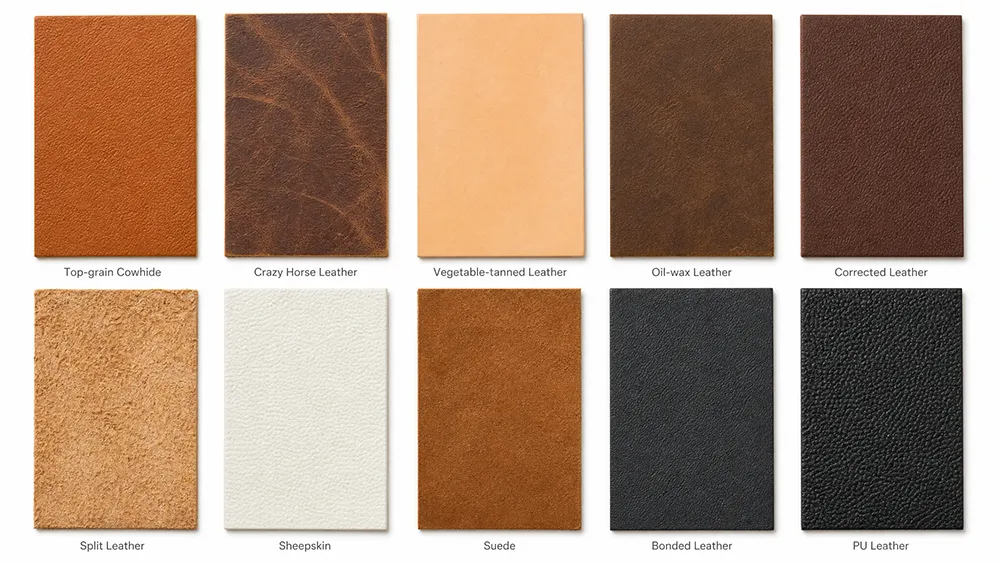
Leather Materials Comparison: 10 Common Leather Complete Chart (Grading, Pros & Cons, Price, Usage)
We classify mainstream leather materials into 4 quality grades based on international leather industry standards, covering core indicators including durability, texture, maintenance difficulty, bulk price range and applicable scenarios for wholesale leather bags.
| Leather Material | Quality Grade | Core Pros & Cons | Maintenance Tips | Wholesale Price Range | Applicable Scenarios |
|---|---|---|---|---|---|
| Top-grain Yellow Cowhide | Grade 1 (Premium) | ✅ Most durable, pure natural texture, develops beautiful patina with use ❌ Slightly high cost, has natural leather grain imperfections | Apply leather conditioner every 3-6 months; avoid direct sunlight and water soaking | Small bags: $15-$45 | Large bags: $45-$120 (bulk wholesale price) | Daily commute bags, business briefcases, high-durability wholesale leather luggage |
| Crazy Horse Leather (Top-grain Cowhide) | Grade 1 (Premium) | ✅ Scratch & water resistant, low maintenance, vintage retro texture ❌ Darkens gradually with use, not suitable for formal business scenarios | No regular conditioner needed; wipe with dry cloth only, keep away with chemical cleaners | Small bags: $18-$50 | Large bags: $50-$130 (bulk wholesale price) | Vintage style bags, outdoor tooling bags, casual bulk leather accessories |
| Vegetable-tanned Leather (Top-grain Cowhide) | Grade 1 (Premium) | ✅ Eco-friendly & odor-free, softens over time, unique patina effect ❌ Water-sensitive, easy to leave scratches, obvious color change | Use special vegetable-tanned leather conditioner every 6 months; wipe off water immediately | Small bags: $20-$60 | Large bags: $60-$150 (custom & bulk order) | Handmade leather goods, premium custom bags, vintage style leather products for enthusiasts |
| Oil-wax Leather (Top-grain Cowhide) | Grade 1 (Premium) | ✅ Excellent waterproof & scratch resistance, glossy finish, shinier with use ❌ Easy to leave fingerprints and bright scratch marks on the surface | Wipe with soft clean cloth; avoid alcohol and harsh chemical detergents | Small bags: $20-$60 | Large bags: $60-$150 (bulk wholesale price) | Business bags, commute tote bags, glossy premium wholesale leather bags |
| Corrected Top-grain Cowhide | Grade 2 (Mid-tier) | ✅ Smooth flat surface, no natural flaws, cost-effective ❌ Coated surface leads to poor air permeability, no patina development | Condition every 3-6 months; prevent sharp object scratches | Small bags: $12-$38 | Large bags: $38-$90 (bulk price) | Budget daily commute bags, mass-market wholesale leather products |
| Split Cowhide | Grade 3 (Entry-level) | ✅ Ultra-low cost, similar appearance to top-grain leather ❌ Poor durability, easy peeling, stiff texture | Condition every 2-3 months; minimize water contact | Small bags: $5-$22 | Large bags: $22-$45 (bulk wholesale) | Entry-level leather bags, low-budget bulk daily leather goods |
| Genuine Sheepskin | Grade 2 (Mid-tier) | ✅ Ultra-soft & lightweight, delicate high-end texture ❌ Fragile & scratch-prone, high maintenance cost | Use special sheepskin conditioner every 2-3 months, avoid sharp items | Small bags: $30-$90 | Large bags: $90-$220 (custom bulk order) | Ladies mini bags, evening clutch bags, luxury lightweight leather accessories |
| Suede Leather (Nubuck) | Grade 3 (Entry-level) | ✅ Matte premium texture, soft hand feel ❌ Dust-absorbent, hard to clean, extremely water-sensitive | Clean with professional suede brush; strictly avoid water and oil stains | Small bags: $10-$30 | Large bags: $30-$75 (bulk price) | Casual daily bags, autumn and winter style wholesale leather products |
| Recycled Bonded Leather | Grade 4 (Economy) | ✅ Extremely low price, neat flat appearance ❌ Poor durability, glue odor, easy cracking and deformation | No special maintenance required, replace once damaged | Small bags: $3-$12 | Large bags: $12-$30 (bulk wholesale) | Fast fashion leather bags, short-term use disposable leather goods |
| PU/PVC Faux Leather (Non-Genuine) | Non-leather | ✅ Super low cost, diverse styles, water resistant ❌ Poor air permeability, easy peeling, pungent chemical smell | Wipe with damp cloth, keep away from high temperature environment | Small bags: $2-$8 | Large bags: $8-$25 (bulk price) | Fast fashion casual bags, low-cost short-term wholesale accessories |
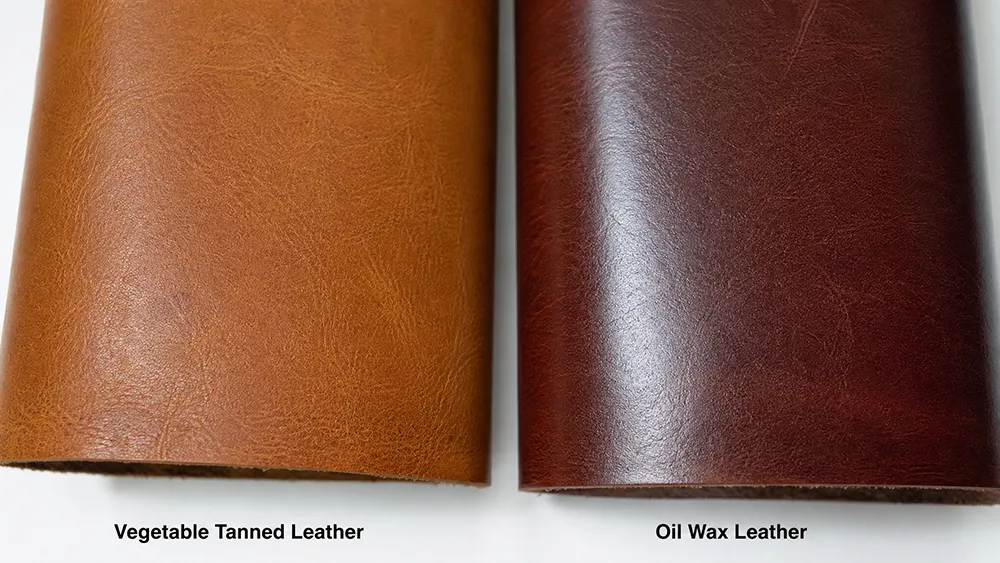
Vegetable-tanned Leather vs Oil-wax Leather: 3 Core Differences
As two of the most popular top-grain leather materials for custom and wholesale leather bags, vegetable-tanned leather and oil-wax leather are often confused by global buyers. Their core differences lie in craftsmanship, texture and applicable customer scenarios, which are critical for bulk order selection.
1. Craftsmanship Difference
Vegetable-tanned leather is processed with pure plant tanning agents without chemical additives, featuring eco-friendly and non-toxic properties, which is favored by environmental-focused wholesale brands. Oil-wax leather is made by impregnating top-grain cowhide with special oil wax, forming a natural glossy protective layer on the leather surface.
2. Texture & Aging Effect Difference
Vegetable-tanned leather is stiff at first, gradually softening and darkening to form a warm natural patina with long-term use, perfect for customers who love aging leather texture. Oil-wax leather is soft and flexible originally with a bright glossy surface; minor scratches will turn into shiny marks, making the leather glossier and more textured over time with low maintenance.
3. Applicable Scenario Difference
Vegetable-tanned leather is ideal for premium custom leather goods, handmade crafts and vintage collections, targeting high-end consumer groups. Oil-wax leather is more suitable for daily commute business bags and casual tote bags, meeting the low-maintenance needs of mass consumers, making it a bestseller in bulk wholesale orders.
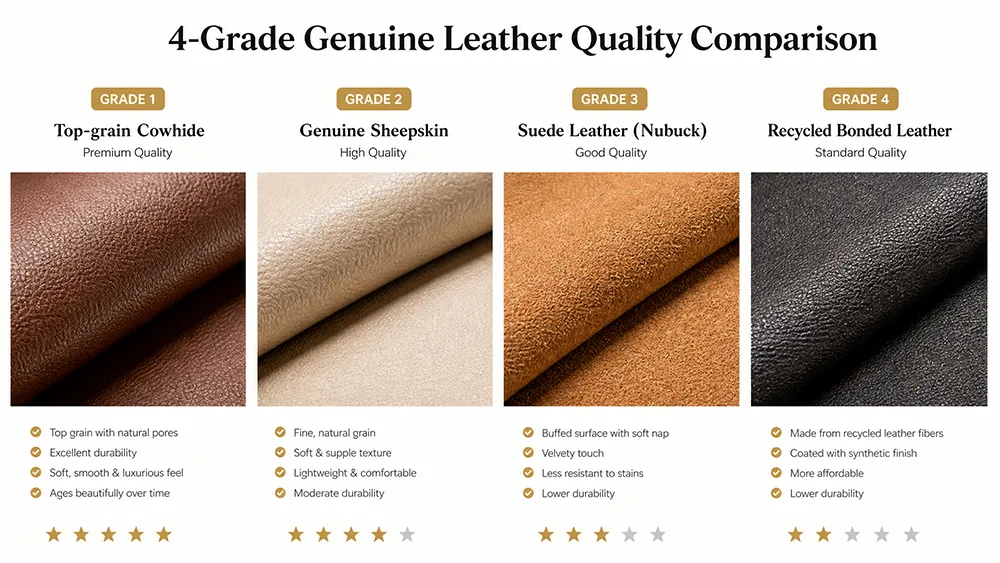
Genuine Leather Quality Grading Standards (Global Industry Standard)
Based on leather thickness, fiber density, durability and craftsmanship, we sort leather materials from highest to lowest quality: Grade 1 Top-grain Leather > Grade 2 Corrected Top-grain/Sheepskin > Grade 3 Split Leather/Suede > Grade 4 Recycled Bonded Leather.
Higher leather grades represent better durability, more natural texture and higher market value, with corresponding higher wholesale prices. For bulk buyers focusing on cost performance, Grade 1 top-grain cowhide is the most cost-effective choice. Marrant Leather provides factory-direct wholesale leather bags and custom leather products, eliminating brand premium and offering high-grade leather goods at competitive bulk prices for global retailers.
👉 Learn more: How to identify genuine‑leather bags?
Frequently Asked Questions
Q1: Which is more durable, vegetable-tanned leather or oil-wax leather?
Both Grade 1 leathers have similar durability, with a service life of more than 5 years for daily use. Oil-wax leather requires almost no daily maintenance, more suitable for mass wholesale daily bags. Vegetable-tanned leather needs regular care but has a unique aging patina, perfect for high-end custom leather product orders.
Q2: What is the most cost-effective leather material for daily wholesale bags?
Crazy horse leather and ordinary top-grain yellow cowhide are the top choices. They feature ultra-high durability, simple daily maintenance, and a service life of over 10 years, balancing quality and wholesale price, suitable for large-batch daily bag customization and wholesale.
Q3: What is the core gap between low-cost and high-end genuine leather?
The core gap lies in leather grades and fiber density. The cost of Grade 1 top-grain leather is 3 times higher than Grade 3 split leather, while its durability is 3-5 times better. For long-term bulk wholesale business, high-grade top-grain leather products have lower after-sales rate and higher customer repurchase rate, bringing more stable profits for wholesalers.
Conclusion
In short, accurate leather material selection is essential for wholesalers and custom leather bag suppliers to optimize product quality and market competitiveness. Grade 1 top-grain leathers, including top-grain cowhide, crazy horse leather, vegetable-tanned leather and oil-wax leather, stand out for premium durability and texture, ideal for high-quality bulk orders and custom leather projects.
For cost-effective daily wholesale bags, crazy horse leather and standard top-grain cowhide are the best options. Vegetable-tanned leather suits high-end vintage custom goods, while mid-grade and entry-level leathers cater to budget fast-fashion demands.
As a professional leather goods supplier, Marrant Leather offers reliable bulk wholesale and custom leather bag solutions. Proper leather matching lowers after-sales risks, upgrades product grade, and brings stable long-term value to your global leather business.
👉 Discover More Genuine Leather Bags
Content may be reused for non‑commercial purposes with source credit: Marrant Leather Official Site.