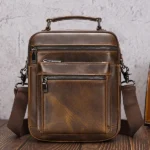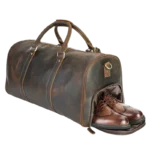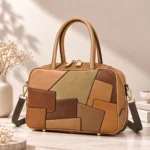
The words full-grain, top-grain, genuine leather and split leather appear on thousands of product pages. They look like a simple ranking system. In reality, cowhide leather grades are not governed by one universal ladder from “best” to “worst.” These terms describe where the leather comes from in the hide, whether the natural grain remains, and how the surface has been treated. They do not, by themselves, guarantee the quality of the hide, tanning, finish or finished bag.

That distinction matters to brand owners, wholesalers and product developers. A beautiful full-grain hide can be unsuitable for a highly structured handbag. A carefully made corrected-grain leather can outperform a delicate aniline leather in wet weather. And a quotation that says only “genuine leather” leaves too many variables undefined for reliable sourcing.
This white paper explains cowhide leather grades in practical, technically accurate language. It also provides a framework for comparing samples, writing purchase specifications and choosing the right cowhide for leather bags.
Why the Traditional Four Grades of Leather Chart Is Misleading
Many online guides present a neat hierarchy:
Full-grain > top-grain > genuine leather > bonded leather
It is memorable, but it mixes different kinds of terms. Full-grain describes an intact grain surface. Top-grain usually describes the upper split of the hide, although marketplace usage varies. Genuine leather is a broad authenticity claim. Bonded leather is a composite made with leather fibers or particles and binders rather than an intact hide structure.
The leather trade uses precise definitions instead of treating these labels as four official cowhide leather grades. ISO 15115 defines full-grain leather by the condition of its grain and corrected-grain leather by the mechanical removal and subsequent enhancement of that grain. The Leather Working Group uses definitions aligned with ISO, CEN and UNECE terminology.
This does not mean every leather is equal. Hide selection, fiber structure, tanning, thickness, finishing and test performance all affect the result. A one-word grade cannot capture them.
Start with the Structure of a Cowhide
To understand cowhide leather grades, picture a hide in cross-section.
The outer side, after the hair and epidermis are removed, is the grain. Immediately beneath it is a tightly interwoven fiber network. Fibers become larger and more open toward the flesh side. A thick cowhide is commonly split horizontally during production.
The upper layer is the grain split, often called top grain. It contains the natural grain surface and the densest fiber structure. The lower layer is the flesh split, usually called split leather. Depending on hide thickness and processing, additional middle splits may be produced.
Surface treatment creates another axis of classification. A grain split may retain its original surface, be lightly buffed, be more heavily corrected, receive a transparent finish or be covered with a pigmented finish. Therefore, “layer” and “finish” should never be treated as the same question.
The Main Cowhide Leather Grades and Categories
Full Grain Cowhide
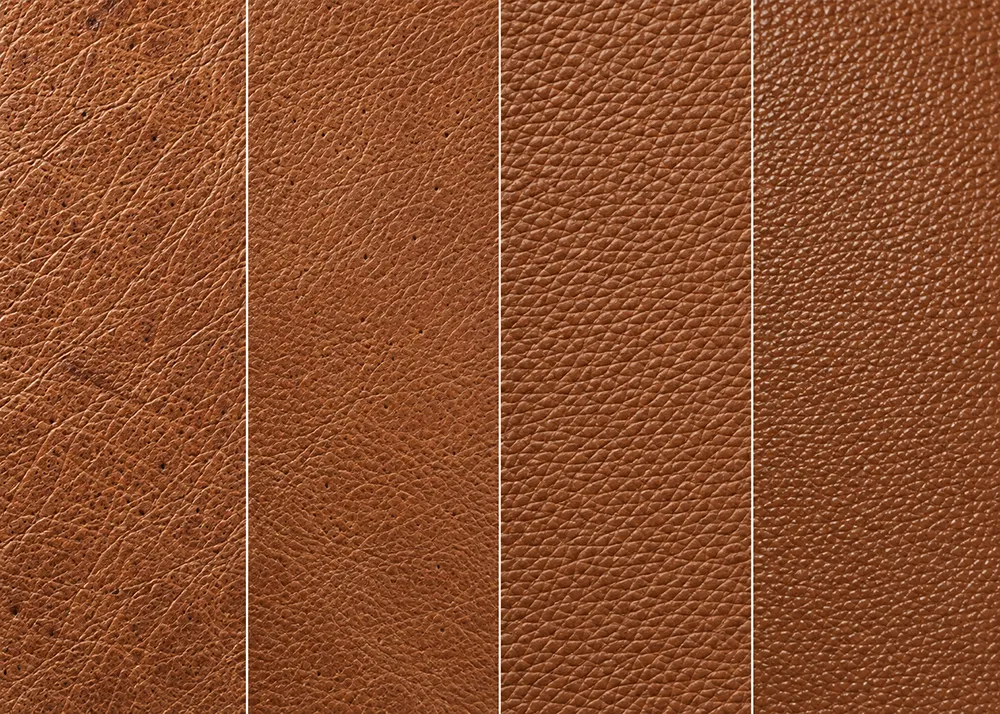
Full-grain leather keeps the entire grain, with no surface removed through corrective mechanical treatment. Natural pores, growth marks, small scars and variations may remain visible. Those features are not automatically defects; within an agreed visual standard, they are evidence that the original surface is present.
Because the dense grain structure remains intact, full-grain cowhide is valued for strength, natural character and patina. Pull-up, oil-wax and vegetable-tanned leathers can be full-grain, but those names describe effects or tanning systems rather than grades.
Full-grain suits heritage bags, briefcases and products designed to age visibly. Natural variation can reduce cutting yield, while pale or minimally finished surfaces may show water, oil or scratches more readily.
Full-grain does not mean “unfinished.” A full-grain leather can receive dyes, oils, waxes and a light protective finish as long as corrective mechanical treatment has not removed the grain. Buyers should ask whether the surface is aniline, semi-aniline or pigmented, and how much visual variation is acceptable.
Top Grain Cowhide
Top-grain leather is one of the most confusing terms in the market. In technical and tannery usage, the top-grain portion is the grain split and may include both full-grain and corrected-grain leather. Some industry sources even use top-grain and full-grain as equivalent terms. In consumer product listings, however, “top-grain” commonly refers to grain leather that has been lightly buffed for a cleaner, more consistent surface.
Do not rely on “top-grain cowhide” alone. Ask: Has any natural grain been removed by buffing or another corrective process? If no, the leather meets the defining feature of full-grain. If yes, it is corrected grain, even when correction is light.
In common commercial usage, top-grain cowhide is popular for handbags, backpacks and business bags because it can balance appearance, cutting yield and predictable color. The quality range is broad, so approve a reference swatch.
Corrected Grain Cowhide
Corrected-grain leather is grain leather whose surface has been partially removed through buffing or a similar mechanical process and then enhanced with finishing. The finish may include pigments, binders and an embossed grain pattern.
Correction is not automatically poor manufacturing. It reduces visible scars, standardizes color and texture, and can create an easier-care surface—useful for large, visually consistent collections.
The trade-off is that a heavier correction or coating can reduce the natural look and feel. Over time, failure may occur in the finish before it occurs in the leather structure. The buyer should therefore assess both the substrate and the coating. Flex resistance, dry and wet rub fastness, adhesion and cold-crack behavior may be more informative than appearance alone.
Corrected-grain cowhide often suits uniform collections, work bags and products needing repeatable color. Judge the extent of correction and the performance of the finished article.
Split Cowhide
Split leather is made from the lower layer remaining after the grain split has been removed. It has a more open fiber structure and no original grain surface. It may be left with a nap to make suede, or coated and embossed to imitate grain leather.
Split cowhide is legitimate when accurately labeled and matched to the product. It offers even thickness and cost efficiency for linings, suede items and value-focused accessories. A coated split should not be presented as full-grain or top-grain cowhide.
Examine the cut edge or reverse side. Grain leather normally shows a dense surface zone merging into the fibers. Finished split may show a distinct film over a fibrous base. Use laboratory evaluation when labeling risk is high.
Bonded Reconstituted and Synthetic Materials
Bonded or reconstituted leather is made from leather fibers, particles or pieces combined with binders and formed into sheets. Under the ISO definition, material made by disintegrating hide into particles or powder and reforming it into sheets is not leather in the same sense as an intact tanned hide.
PU and PVC are synthetic materials and contain no requirement for an intact animal-hide fiber structure. Both can reproduce grain patterns with remarkable consistency. They may have valid applications, but they should not be confused with cowhide leather grades or sold under ambiguous material descriptions.
Grain Grade Is Not the Same as Finish Type
A second vocabulary layer describes how the surface looks and behaves:
| Term | What it generally means | Key sourcing implication |
| Aniline | Color is created mainly with transparent dyes; natural surface remains visible | Rich character, but marks and color variation are more apparent |
| Semi-aniline | Transparent or lightly pigmented finish adds some protection | Balance of natural appearance and practical resistance |
| Pigmented | Opaque pigments and a protective finish create uniform color | Consistent and easier to maintain; test finish durability |
| Nubuck | Grain surface is lightly buffed to create a velvet-like nap | Sensitive to soiling and requires special care |
| Suede | Nap is created on the flesh side or on split leather | Specify whether it is grain leather or split suede |
| Pull-up | Oils or waxes move when the leather is bent, creating a lighter color effect | Desired variation must be approved on a physical standard |
| Patent | A glossy coating produces a mirror-like surface | Flexing, adhesion and cold conditions deserve attention |
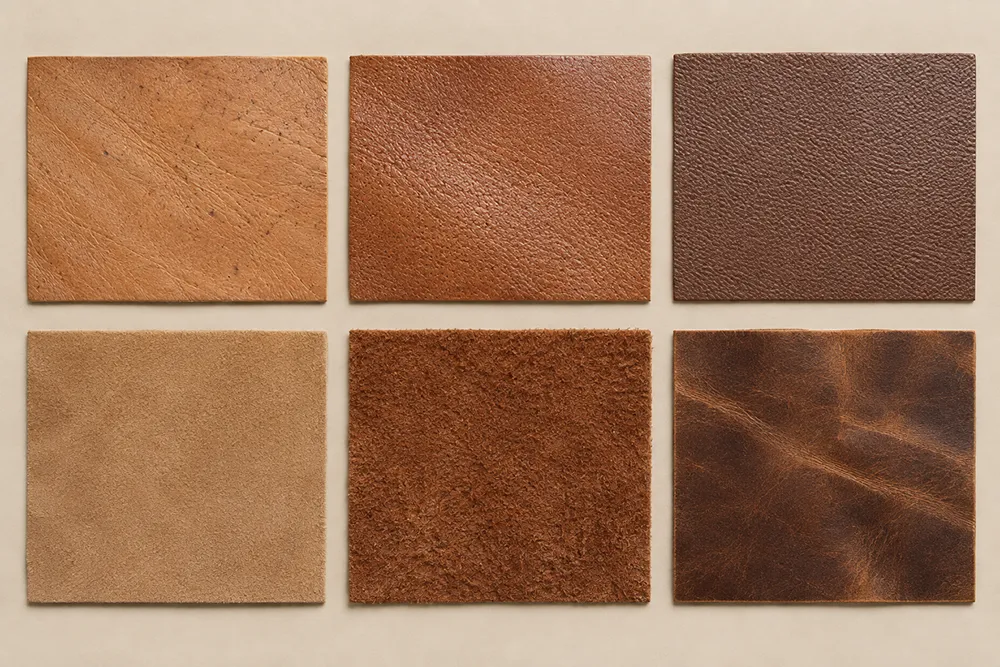
These terms overlap with cowhide leather grades. Full-grain may be aniline or semi-aniline. Nubuck is intentionally buffed, so it is not full-grain under the strict definition. “Crazy horse” describes a waxed pull-up effect, not a species or formal grade.
What Actually Determines Leather Quality
Raw-hide condition, preservation and the panel’s location on the hide affect fiber structure and cutting yield. Tannage influences handle, color range, aging and production time, but chrome, vegetable, chrome-free and combination systems can all produce excellent leather when controlled.
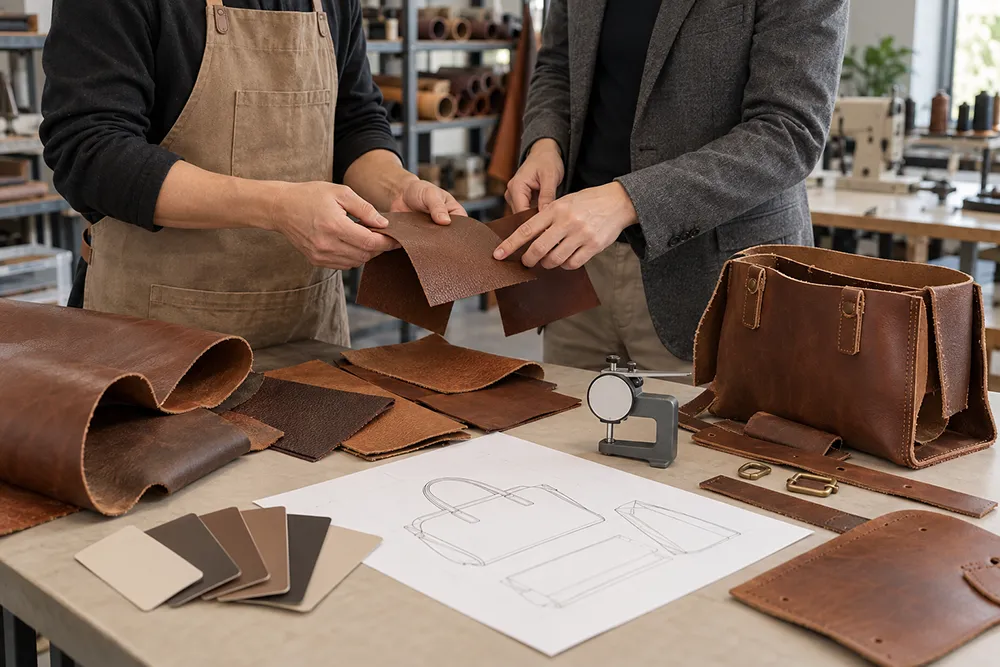
Thickness must suit the product: a slim wallet, soft handbag and travel duffel require different substance. Specify a target and tolerance for body panels, handles and trims. Also approve finish, hand feel and appearance; words such as “soft” or “premium” are too subjective alone.
Finally, bag engineering matters. Strap attachment, seam allowance, stitch density, edge finishing, reinforcement and hardware weight influence service performance. Leather and construction should be developed together.
How to Identify and Compare Cowhide Samples
No single home test can prove every material claim. Use several observations and request documentation.
- Inspect the grain under angled light. Full-grain often shows irregular pores and subtle variations. Perfectly repeated grain can indicate embossing, although natural-looking embossing is increasingly sophisticated.
- Check a clean cut edge. Look for the transition from a dense grain zone to the looser fiber network. A separate surface film over a uniform fibrous layer may indicate coated split leather.
- Bend the sample gently. Observe whether the grain wrinkles naturally, whether pull-up color appears and whether a coating turns white, separates or cracks.
- Compare several pieces, not one swatch. Natural leather varies across a hide and across lots. Review the best, average and worst acceptable panels.
- Do not rely on smell. Odor depends on tanning, oils, waxes, finishes, storage and packaging. Fragrance can also be added.
- Avoid destructive burn tests on finished goods. Coatings, adhesives, foam and thread can distort the result and create hazardous fumes.
- Use an independent laboratory when the claim matters. Material identification, coating structure and physical tests provide stronger evidence than touch or appearance alone.

For a consumer-level inspection workflow, see Marrant’s guide on how to identify a genuine leather bag.
How to Specify Leather for an OEM Bag Order
A good request for quotation should turn cowhide leather grades into verifiable requirements. Include:
- Species and material: cowhide leather.
- Construction: full-grain, corrected-grain or split leather; state whether embossing is allowed.
- Tannage: chrome, vegetable, chrome-free or another agreed system.
- Finish: aniline, semi-aniline, pigmented, pull-up or other named article.
- Thickness: target in millimeters with an agreed tolerance for each component.
- Color: physical master swatch plus a color tolerance or instrument-based standard where necessary.
- Appearance: acceptable scars, wrinkles, grain variation, shade variation and panel matching.
- Hand feel: approved reference swatch for softness, temper and touch.
- Performance: agreed pass/fail requirements for tensile strength, tear load, flex resistance, finish adhesion and dry/wet rub fastness as relevant.
- Chemical compliance: market-specific restricted-substance requirements and current test reports from an agreed laboratory.
- Traceability: tannery, article code, batch or lot number and certificate requirements.
Relevant international test methods include ISO 3376 for tensile strength and elongation, ISO 5402-1 for flex resistance, and ISO 11640 for color fastness under repeated rubbing. The test method alone is not a quality threshold. Buyer and supplier must also agree on the required result, conditioning, sampling plan and consequences of failure.
An effective specification might read:
Full-grain cowhide, semi-aniline finish, natural fine grain, no corrective buffing, 1.4 mm target thickness for body panels, approved dark-brown master swatch, with lot traceability and mutually agreed physical and chemical test requirements.
That sentence is far more useful than “Grade A genuine leather.”
Matching Cowhide Leather Grades to Bag Applications
Luxury and heritage collections: Full-grain aniline, semi-aniline or pull-up cowhide emphasizes natural character. Approve realistic variation limits.
Fashion handbags: Lightly corrected top-grain can provide refined hand feel and consistent color. Check pale colors for transfer against clothing.
Business briefcases and backpacks: Either full-grain or corrected-grain can work. Prioritize structure, reinforcement, rub fastness and flex performance.
Travel bags: Balance tear strength, weight, water response and abrasion. Heavy-looking leather is not necessarily the best solution.
Corporate programs: Corrected grain often supports consistent branding and repeat orders. Confirm logo compatibility with the finish.
Price-sensitive collections: Split leather may be appropriate when transparently specified and tested, subject to applicable labeling rules.
Questions to Ask a Leather Bag Manufacturer
Before placing an order, ask:
- Is the material grain leather or split leather, and is the grain intact or corrected?
- Is an artificial grain embossed onto the surface?
- What are the tannery, article name, thickness and tolerance?
- Which natural marks are acceptable on visible panels?
- Can you provide a swatch, cut-edge image and finished sample bag?
- Which physical and colorfastness tests are available for the production lot?
- How are lots traced, and what happens if bulk differs from the approved standard?
A capable OEM partner should answer these questions in concrete terms and help convert aesthetic goals into production controls.
Frequently Asked Questions
Q1: What is the highest grade of cowhide leather
A1: Full-grain is commonly positioned highest because its natural grain remains intact. However, there is no single official global ranking. The best choice depends on appearance, performance and budget.
Q2: Is top grain leather real leather
A2: Yes. Top-grain refers to leather from the grain-side portion of a hide. The term may include full-grain and corrected-grain material, so buyers should ask whether the surface has been buffed or corrected.
Q3: Is genuine leather a low grade
A3: Not as a formal definition. “Genuine leather” means the material is real leather, but it does not state which layer or finish was used. In some retail contexts it is associated with lower-cost leather, which is why a more precise description is preferable.
Q4: Does full grain leather always last longer
A4: An intact grain can support durability, but longevity also depends on hide quality, tanning, finish, construction, use and care.
Q5: Is corrected grain leather good for bags
A5: Yes. It can offer uniform color, efficient cutting and surface protection. Evaluate flexing, rub fastness, adhesion and sample-bag performance.
Q6: Is Crazy Horse leather full grain
A6: “Crazy Horse” describes a waxed or oiled pull-up look, not a formal grade. It can be made on full-grain or corrected-grain cowhide. Confirm the underlying grain construction with the supplier.
Q7: How can I verify leather quality before a bulk order
A7: Approve a traceable swatch and sample bag, document appearance limits and test thresholds, and inspect production against the signed standard. Use third-party testing when risk is significant.
From Grade Name to Reliable Product
Understanding cowhide leather grades protects buyers from vague claims, but terminology is only the first layer of quality control. The strongest sourcing decisions connect a precise material description to a physical standard, measurable performance, compliant chemistry and bag construction designed for the application.

Marrant works with brands, retailers and wholesalers on leather selection, sampling, OEM/ODM development, private labeling and bulk production. Explore our leather bag customization options or contact the Marrant factory to discuss your target style, price position, leather finish and order quantity. Share a reference image or specification, and our team can help translate it into a sample you can evaluate before production.
👉 View Full-Grain Leather Customization Options
Content may be reused for non‑commercial purposes with source credit: Marrant Leather Official Site.