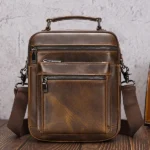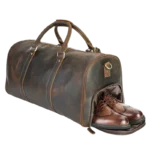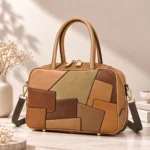
Searching for China genuine leather bag suppliers usually leads buyers to three major manufacturing regions: Hebei, Guangdong, and Zhejiang. Their ecosystems are not interchangeable. A capable PU-handbag factory may not suit a full-grain leather brief, while a large luggage exporter may have limited experience with soft-structured fashion bags or hand-painted edges.

The practical question is therefore not “Which province is best?” It is “Which cluster best fits the product, order structure, quality level, and destination market?”
This guide compares Baigou in Hebei, Shiling in Guangdong, and Pinghu in Zhejiang from a buyer’s perspective, including supply-chain depth, development fit, quality control, compliance, and shipment inspection.
The short answer is:
- Shiling, Guangdong is usually the strongest starting point for fashion-led genuine leather handbags and complex material or hardware development.
- Baigou, Hebei is attractive for broad bag categories, rapid commercialisation, price-sensitive programs, and flexible e-commerce supply, but buyers must screen specifically for proven leather capability.
- Pinghu, Zhejiang is well suited to structured OEM/ODM programs, travel goods, business bags, and export-oriented production management, although its cluster identity is more luggage-focused than leather-fashion-focused.
These are tendencies, not guarantees. Make the final decision at factory level using samples, records, and an agreed inspection plan.
What “China Genuine Leather Bag” Should Mean in a Purchase Specification
“Genuine leather” is too broad to function as a complete technical specification. In retail language, it simply indicates that the material is leather; it does not automatically describe animal species, grain quality, tanning route, finish, thickness, hand feel, or durability.
A workable request for quotation should define at least:
- Leather type: full-grain, corrected-grain, split leather, suede, or another agreed construction
- Species: cowhide, calfskin, goatskin, sheepskin, or other declared source
- Tanning and finish: chrome-tanned or chrome-free, aniline, semi-aniline, pigmented, embossed, waxed, or milled
- Thickness range, measured in millimetres, with tolerance
- Colour standard and acceptable shade variation
- Backing, reinforcement, lining, edge paint, adhesive, and hardware requirements
- Restricted-substance and labelling requirements for the destination market
Ask the supplier to identify every visible and hidden component. Cowhide on the body, split leather on trim, and microfiber on pocket edges can be valid if disclosed and approved. It becomes a quality problem when the bill of materials, sample, sales claim, and production unit do not match.
For EU-bound products, chemical compliance deserves early attention. EU REACH Annex XVII restricts chromium VI in leather articles or leather parts that come into contact with skin at 3 mg/kg or above, based on the dry weight of the leather. Buyers should confirm the exact current requirements for their market and product before ordering, then use an accredited laboratory where testing is required. The legal threshold and scope are stated in the European Commission regulation.

At-a-Glance Comparison of the Three Industry Clusters
| Decision factor | Baigou, Hebei | Shiling, Guangdong | Pinghu, Zhejiang |
|---|---|---|---|
| Core cluster strength | Broad bag assortment, wholesale, e-commerce, rapid response | Leather goods, fashion handbags, materials, hardware, development ecosystem | Travel goods, luggage, structured export manufacturing |
| Best-fit products | Backpacks, totes, casual bags, promotional and mixed-material collections | Genuine leather handbags, wallets, small leather goods, fashion-led OEM/ODM | Travel bags, business bags, luggage-adjacent products, repeat export programs |
| Genuine-leather sourcing depth | Available, but supplier screening is essential | Generally the deepest of the three | Available through selected factories; less central to cluster identity |
| Development style | Fast commercial adaptation and wide price ladder | Strong material selection, styling, sampling, and component sourcing | More process-led engineering and repeatability |
| Likely buyer fit | E-commerce sellers, wholesalers, value brands, mixed SKU programs | Fashion brands, private labels, importers needing leather specialisation | Established importers, travel brands, programs requiring structured production control |
| Main due-diligence risk | Trading-company confusion; material substitution; uneven factory capability | Wide supplier-quality spread; complex subcontracting; IP exposure | Factory may be optimised for luggage rather than soft leather handbags; higher program rigidity |
Hebei: Baigou’s Advantages and Limitations
Why Baigou Matters
Baigou has developed a broad, highly commercial bag ecosystem covering raw materials, design, processing, manufacturing, wholesale, online sales, and logistics. An official Xiong’an report describes a supply chain built over more than four decades and notes that Baigou’s 2023 bag-industry output reached RMB 41.9 billion, with roughly RMB 30 billion generated through online sales. It also reports more than 1,000 newly developed bag patterns through digital design initiatives. These figures illustrate the cluster’s scale and speed, although they cover bags generally rather than genuine leather bags alone.
This density makes it easier to source common components, respond to online-market feedback, and compare construction and price options in one trip.
Where Baigou Performs Best
Baigou is practical for backpacks, casual totes, commuter bags, camera bags, travel bags, or mixed PU, textile, and leather ranges. It also fits frequent SKU refreshes and mainstream online price points.
Its commercial responsiveness helps when development requires quick changes to webbing, zipper gauge, lining, or packaging.
Where Buyers Need More Control
Baigou’s scale is mainly a bag-manufacturing advantage, not proof that every supplier is a genuine-leather specialist. During factory qualification, buyers should verify whether cutting, skiving, edge painting, stitching, and final assembly are handled in-house or subcontracted. They should also review leather purchase invoices, supplier names, batch references, and material yield records.
A useful control is a signed board carrying the approved leather, lining, reinforcement, edge paint, and hardware. Compare it with bulk materials under consistent lighting, then sample cut panels for thickness, finish, colour, and backing. This is more reliable than a showroom label saying “100% genuine leather.”
Baigou’s greatest advantage is choice; its corresponding risk is variability. It is strongest when the buyer has a precise tech pack and active quality assurance.
Guangdong: Shiling’s Advantages and Limitations
China’s Most Concentrated Leather-Goods Ecosystem
Shiling, in Guangzhou’s Huadu District, is widely recognised for leather goods and bags. A 2024 report hosted by Guangdong’s tax authority describes it as one of China’s most concentrated and complete leather-goods production bases, with more than 8,800 bag and leather-goods enterprises and over 16,800 supporting merchants. The same source traces the local industry to 1978 and describes current efforts to connect material suppliers, processors, and manufacturers through digital production systems.
That ecosystem matters because grading, colour matching, splitting, skiving, reinforcement, metal finishing, moulds, edge paint, and handwork all affect a leather bag. The wider Pearl River Delta also provides design, packaging, freight, and testing services.
Where Shiling Performs Best
Shiling is generally the best first stop for fashion handbags, crossbody bags, structured totes, wallets, small leather goods, and products with customised hardware. It is particularly useful when the project requires several leather options at the sampling stage or close coordination between pattern maker, material supplier, hardware vendor, and assembly factory.
A structured top-handle bag illustrates the need: too little reinforcement lets the silhouette collapse; too much makes the bag rigid and the turned edges bulky. Shiling’s specialist teams are more likely to understand these handbag-specific trade-offs.

Where Buyers Need More Control
Supplier capability varies widely. A polished showroom does not prove production control. Confirm the payment entity, manufacturing address, in-house processes, and approved subcontractors.
Complex supply networks also require stronger change control. Hardware plating may come from one vendor, edge paint from another, and embossing from a third. The purchase agreement should state that suppliers, materials, finishes, and processes cannot change without written approval. If brand-exclusive moulds are used, document ownership, storage, access, and disposal.
Shiling offers the deepest leather-development environment, but the buyer still needs disciplined supplier mapping and IP protection.
Zhejiang: Pinghu’s Advantages and Limitations
A Strong Export and Travel-Goods Base
Pinghu is known as a major Chinese travel-goods base. Zhejiang government sources describe a mature chain covering bag manufacturing and components; a recent provincial report says the city has more than 400 bag and component companies. Another official report identifies Pinghu’s bags as part of a provincial domestic-and-foreign-trade integration base.
Pinghu’s Yangtze River Delta location supports access to logistics, ports, testing, and a broad manufacturing base. Its export orientation helps buyers who value documentation and repeatable production planning.
Where Pinghu Performs Best
Pinghu is a strong candidate for travel bags, business cases, briefcases, wheeled products, and structured OEM programs where engineering consistency matters. Selected factories can also produce leather or leather-trimmed products, especially when the bag construction resembles business or travel goods rather than highly decorative fashion handbags.
For repeat programs, approved-component lists, inline records, packaging specifications, and carton markings can reduce variation across colours and purchase orders.
Where Buyers Need More Control
Do not assume that a strong luggage manufacturer is automatically a strong leather-handbag manufacturer. Luggage lines often optimise around synthetic shells, textiles, binding, webbing, frames, wheels, handles, and larger assembly stations. Soft leather bags require different material handling, cosmetic inspection, edge work, and craftsmanship.
Ask to see recent comparable production—not only catalogues. Review the pattern room, leather storage, cutting, skiving, edge painting, and grading of natural marks. For small or seasonal projects, confirm that the planning system can accommodate frequent changes.
Pinghu’s strength is controlled, export-oriented production; its limitation is that genuine leather fashion is not the defining capability of every factory in the cluster.
How to Select the Right Cluster for Your Product
Choose by Product Architecture, Not Province Name
Start with the construction. A full-grain leather tote with turned edges and custom brass hardware points toward a leather-goods ecosystem such as Shiling. A leather-trimmed commuter backpack with multiple textile panels may fit Baigou. A structured business case or premium travel bag may fit a qualified Pinghu exporter.
Then consider the commercial model:
- For fast online assortment changes and mixed materials, shortlist Baigou.
- For design-intensive leather goods and complex sampling, shortlist Shiling.
- For stable export programs and travel-oriented engineering, shortlist Pinghu.
Use this shortlist for discovery, not as the final decision.
Use a Comparable RFQ Package
Send every candidate the same package: drawings, tolerances, bill of materials, leather specification, colour references, logo methods, workmanship standard, packaging, quantity by colour, target market, tests, and inspection level.
Request separate tooling, sample, testing, packaging, and delivery terms. A low unit price may hide weaker packaging, untested material, or a different Incoterm. Compare only aligned scopes.
Evaluate the Sample as a Production System
A good sample is not enough. Record who made it, which materials were used, and whether they are available for bulk. Seal an approval sample and material board; create a measurement table and photo defect library.
During sample testing, inspect:
- Leather thickness and shade consistency across panels
- Dry and wet rubbing behaviour where relevant
- Stitch density, backstitching, skipped stitches, and seam alignment
- Handle and strap attachment under the expected load
- Zipper travel, magnetic closure alignment, and hardware finish
- Edge-paint adhesion and cracking after flexing
- Lining fit, pocket function, and interior cleanliness
- Finished dimensions, empty weight, capacity, and actual product application
- Carton fit, deformation risk, desiccant needs, and barcode readability
ASTM publishes leather methods including colourfastness to crocking and stitch-tear strength. Select methods, acceptance values, conditioning, and samples for the product and market rather than copying another bag’s plan.
Factory Testing, Production Control, and Shipment Inspection

Before Production
Convert customer requirements into measurable checkpoints. Before bulk cutting, confirm material batches, grain direction, acceptable natural marks, reinforcement, critical dimensions, stitch colour, hardware protection, packaging, and timing.
The standard must distinguish natural character from defects. Minor grain variation may pass; loose grain, prominent scars, finish peeling, mismatched shades, or unauthorised splicing may not. Define grading zones for visible and hidden panels.
During Production
Inspect early enough to correct the process; finished-goods checks may come after all leather is cut. Review first output for pattern accuracy, symmetry, seam allowance, skiving, reinforcement, edge preparation, and hardware position.
For traceability, record the leather supplier, lot reference, colour batch, production line, and inspection date. Retain material cuttings for higher-risk orders.
Before Shipment
Final random inspection should use an agreed sampling plan and defect classification. The inspection scope normally covers quantity, assortment, workmanship, measurements, function, packaging, labels, carton marks, and simple on-site tests specified in the inspection protocol. Laboratory chemical or performance tests should be completed separately when required; a visual shipment inspection cannot establish chemical compliance.
Open cartons across the shipment, not only top layers. Check mould risk, colour transfer, crushed handles, scratches, mixed shades, tacky edge paint, odour, wrapping, and stuffing.
Release only when inspection, lab reports, approved deviations, and shipping documents match the purchase order.
Send Your Requirements — Share your tech pack, target quantity, leather specification, destination market, and required delivery date. We can help structure a supplier comparison around comparable materials, production capability, quality controls, and landed-risk factors rather than headline unit price alone.
Common Sourcing Mistakes to Avoid
Treating “Genuine Leather” as a Grade
It is not a complete grade. Specify species, layer, finish, thickness, colour, and performance. Require disclosure of non-leather components and confirm labelling rules for the destination market.
Selecting a Supplier from a Marketplace Profile Alone
Online profiles may combine factory, trading, and outsourced capabilities. Verify the site, entity, records, and comparable products.
Approving a Sample Without a Controlled Bill of Materials
Record each component’s supplier or code, colour, finish, dimensions, and approved alternatives. Prohibit substitution without written consent.
Leaving Quality Standards Until Final Inspection
Agree on appearance zones, measurements, function tests, defect severity, and sampling before production; final inspection cannot repair a weak process.
Choosing a Cluster Before Defining the Product
The cluster should follow the brief. A vague request produces vague quotations and makes suppliers appear more similar than they are.

Frequently Asked Questions
Q1. Which Chinese region is best for genuine leather handbags?
Shiling in Guangdong is usually the strongest starting point because leather goods, material vendors, hardware suppliers, processors, and handbag development resources are concentrated in the area. However, a qualified factory in Baigou or Pinghu may be better for a specific product. Audit the actual supplier and test the sample.
Q2. Is Baigou only suitable for low-cost bags?
No. Its wide capability range supports multiple price levels, and the cluster is investing in design and digital manufacturing. Quality varies, so qualify the exact leather construction and control bulk materials.
Q3. Is Pinghu suitable for leather bags or only luggage?
Selected Pinghu suppliers produce leather and leather-trimmed bags, especially structured business or travel products. Ask for recent, comparable production evidence.
Q4. How can I verify that a bag is made from the agreed leather?
Use a bill of materials, signed material board, supplier documents, batch traceability, physical examination, and laboratory analysis where necessary. Do not rely on smell, burn tests, labels, or sales claims.
Q5. What should be checked during a leather bag factory audit?
Check the legal entity, leather storage, pattern making, cutting, skiving, stitching, edge finishing, hardware, subcontracting, quality records, chemical management, capacity, worker safety, and traceability.
Q6. What tests should a genuine leather bag pass?
Depending on construction and market, test colourfastness, finish adhesion, flex resistance, stitch-tear strength, strap attachment, closures, hardware corrosion, restricted substances, and packaging. Agree acceptance criteria before production.
Q7. Should I choose the lowest sample or unit price?
Not without normalising the quotation. Confirm leather grade and yield, hardware specification, lining, reinforcement, packaging, testing, tooling, Incoterm, and quality scope. A lower quote may represent a different product or transfer more risk to the buyer.

Conclusion
China’s major bag clusters offer different forms of value. Baigou provides breadth, commercial speed, and an e-commerce-oriented supply network. Shiling provides the strongest concentration of leather-goods development resources and is often the natural choice for genuine leather fashion bags. Pinghu provides travel-goods expertise, export experience, and process-oriented production for structured programs.
The most reliable sourcing strategy is to match the cluster to the product, then qualify the factory independently. Define the leather precisely, control the bill of materials, approve measurable workmanship criteria, inspect during production, and verify the shipment before release. Location can improve the odds of finding the right capability; it cannot replace due diligence.
Our advantage is a sourcing approach built around product-to-cluster matching, clear material specifications, and practical quality checkpoints. We help buyers compare suppliers on like-for-like requirements so decisions are based on manufacturing fit and controllable risk—not price alone.
👉 View Guangdong Industrial Belt Custom Solutions
Content may be reused for non‑commercial purposes with source credit: Marrant Leather Official Site.