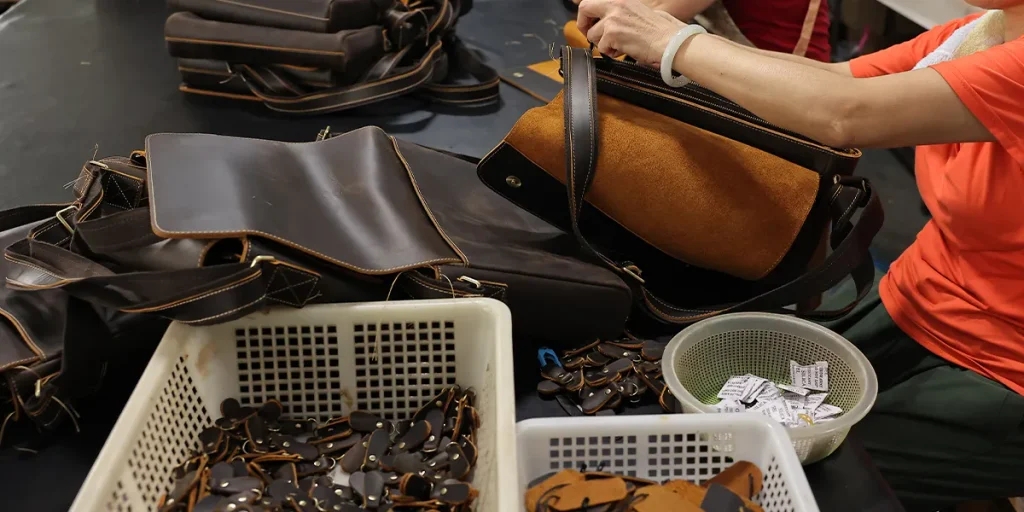
when you work with a leather crossbody bag manufacturer, the product is decided by five things — body size grading, how the strap physically connects to the bag, the closure mechanism, hardware weight, and how production is sampled before bulk. Get these five right at the sampling stage, and your wholesale order practically runs itself. Skip them, and you’ll learn the hard way what “expensive lesson” means.
First, a working definition
A crossbody bag is any bag worn across the torso with the strap running diagonally over one shoulder, resting at the opposite hip. That’s the entire definition. In OEM factory terms, though, it splits into two build families: structured (lined, shaped, often with a zip gusset) and soft (unlined or half-lined, collapsing when empty). The family you choose changes everything downstream — leather thickness, closure options, even stitching count. This is why two quotes for “the same bag” can differ by 40%. They were never the same bag.
Decision 1: Size — grade it by what actually goes inside
Crossbody sizing fails quietly. A bag that’s 2cm too narrow doesn’t get returned; it just never gets used. Here’s how we spec sizes at Marrant Leather Goods based on what buyers actually carry:
| Size Grade | Approx. Dimensions | What It Honestly Fits | Best For |
|---|---|---|---|
| Mini | 20 × 14 × 6 cm | Phone, cardholder, keys | Events, minimalists |
| Compact | 24 × 17 × 8 cm | Phone, wallet, power bank, sunglasses | Daily urban use |
| Standard | 28 × 20 × 9 cm | All above + small paperback, 500ml bottle | Commuting, travel |
| Large | 32 × 23 × 11 cm | Tablet (no case), A5 notebook | Work-carry hybrid |
Our own sampling records from the past year: compact and standard together account for roughly 7 out of 10 wholesale orders. Mini looks great in photos. Standard actually sells through.
Decision 2: Strap attachment — the 30-second stress test
A crossbody strap carries the whole load on two small points. There are three common builds, and the price gap between them is smaller than you’d think:
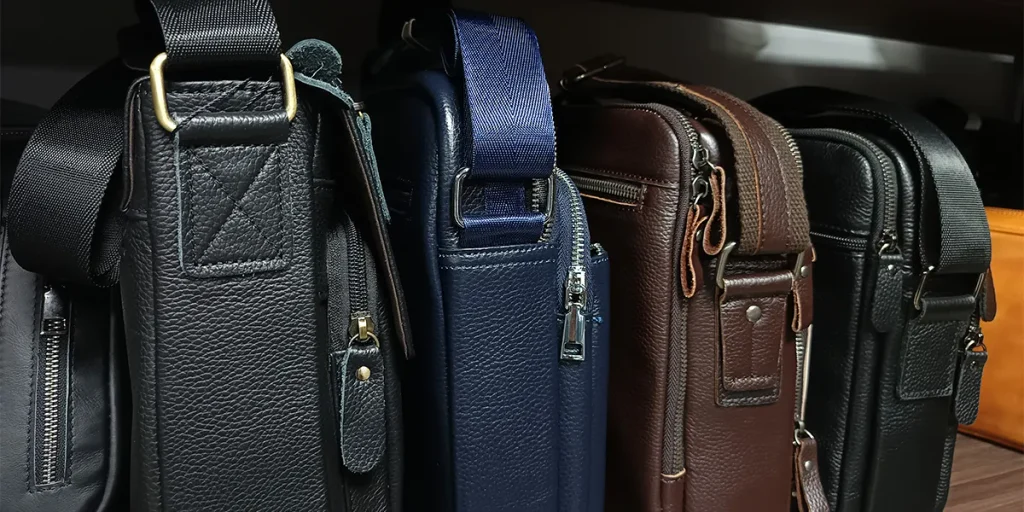
- Leather tab + X stitch — light duty only. Fine for mini sizes under 1.5kg load.
- Metal D-ring + riveted tab — the workhorse. Distributes force through hardware, not thread.
- Reinforced loop integrated into the gusset — the strongest; force flows into the bag’s structure itself.
The 30-second test? Grab the strap near the anchor and pull sharply, twice, at an angle. Any creak, gap, or stitch stretch tells you what six months of daily use will do. Why would anyone ship 500 units before doing a 30-second pull?
Decision 3 & 4: Closure and hardware — where margins hide
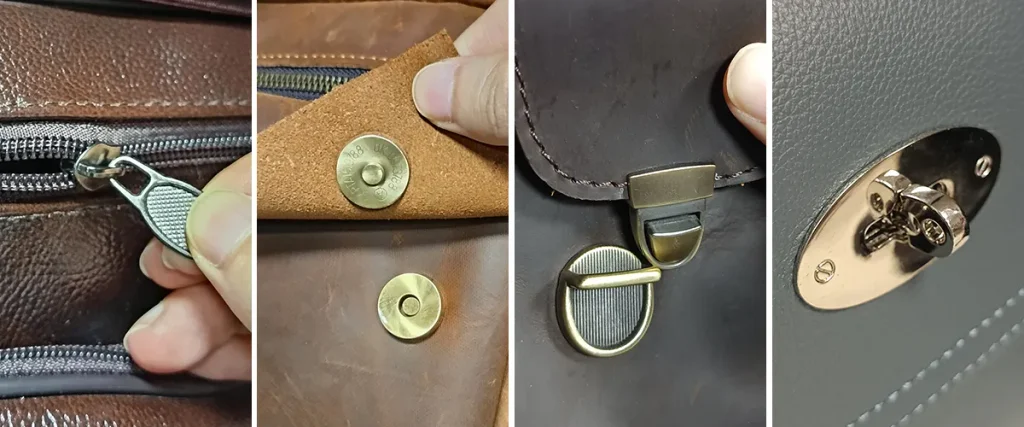
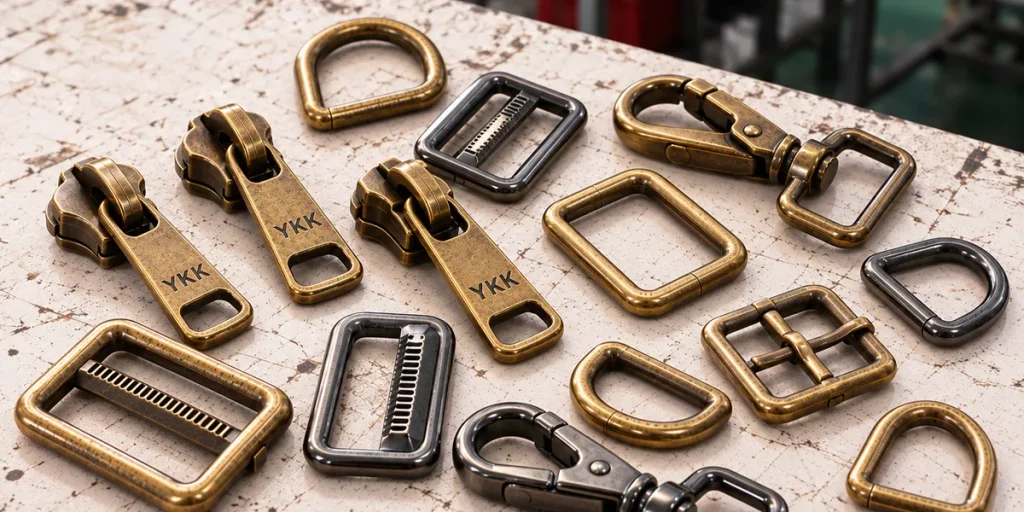
Zipper, magnetic snap, or turn lock? Each closes differently and ages differently. Zippers win on security, snap wins on one-handed access, turn lock wins on perceived value. And hardware — zippers, D-rings, buckles — is typically 15–20% of a crossbody’s total material cost. Cheap hardware doesn’t just feel bad; it dies first and it kills your reviews first.
| Closure | Security | One-Hand Use | Cost Level | Failure Mode |
|---|---|---|---|---|
| Zipper | High | Awkward | Medium | Slider wear |
| Magnetic snap | Low | Excellent | Low | Magnet demagnetizing |
| Turn lock | Medium-High | Good | Higher | Spring fatigue |
A buyer story from a 50-piece run
A café-and-goods shop in Kyoto ordered 50 custom crossbody bags from us as their first OEM trial — compact size, snap closure, their logo debossed. Modest order. But their brief was precise: they sent us the exact phone model, wallet dimensions, even a photo of their typical customer’s outfit palette. Sampling took one round, not three. That first 50 sold out in six weeks, mostly to regulars who asked when the next batch was coming. Their reorder was 120. The lesson isn’t “small orders stay small.” The lesson is that a precise brief from the buyer beats a big budget every single time.
What nobody in the industry tells you
The strap adjuster — the tri-glide slider, what factories casually call the “slider” — is the most-complained-about part that nobody bothers to spec. Buyers obsess over leather grade and zipper brand, then accept whatever generic slider the factory grabs from a parts bin. A flimsy one drifts: the bag slowly sinks to hip level all day, and the customer blames the whole bag, not a 20-cent part. Spec a locking slider — the kind with a metal tooth that grips the strap — and it adds maybe $0.20 per unit. Twenty cents to remove the most annoying daily failure. Who wouldn’t pay that?
Frequently Asked Questions
Q1: What is the MOQ for wholesale leather crossbody bags?
At Marrant Leather Goods, OEM orders start at 50 units per color. Stock leather shades keep things flexible; unusual colors or custom-dyed hides may push the practical minimum higher — we’ll tell you plainly before you commit.
Q2: Which closure should I choose for a first bulk order?
If your customers prioritize security, go zipper. If the bag is a fashion-led piece, magnetic snap. When in doubt, order samples of both — the cost difference at 50 pieces is trivial compared to committing the wrong choice at 500.
Q3: Can I mix sizes and colors in one OEM order?
Usually yes, within reason. A common structure is one style, two colors, split across two size grades — as long as hardware stays shared, the factory can consolidate production. Browse our crossbody bag collection for base styles that support this kind of mix.
Conclusion
Five decisions. Size grading based on real carry needs, a strap attachment that survives the 30-second pull test, a closure matched to how the bag will actually be used, hardware that won’t die first, and a sampling process done before bulk money moves. That’s the whole game. A leather crossbody bag manufacturer worth keeping is one who walks you through all five — on a 50-piece order, not just a 5,000-piece one. At Marrant Leather Goods, that’s been the deal from day one.