
GPSR for leather bags sold to EU consumers has applied since 13 December 2024. For an ordinary non-electronic leather bag that is not a toy, personal protective equipment or otherwise covered by product-specific safety legislation, Regulation (EU) 2023/988 provides the main general product-safety framework. Other rules, including applicable chemical requirements such as REACH, can still apply.
Two obligations are often missed in international sourcing projects. First, the manufacturer must prepare the technical documentation required by Article 9 before placing the product on the EU market. Second, an online offer targeted at EU consumers must clearly display the information required by Article 19. Missing technical documentation can prevent a product from being lawfully placed on the market. Missing Article 19 information makes the online offer non-compliant and may lead to platform or authority action.
What the GPSR Technical File Is — and a 2026 Clarification
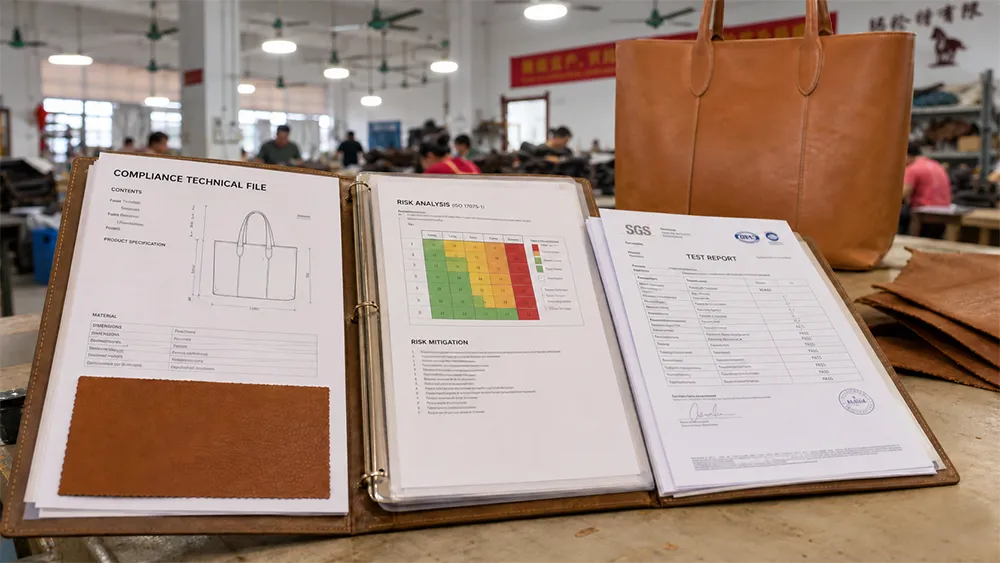
The technical file is the manufacturer’s evidence that a product is safe: an internal risk analysis plus documentation proportionate to the product’s complexity. For a leather bag, that means honest reasoning about sharp edges, strap failure, dye transfer and small detachable parts. Nobody in the industry tells you this part, so we just did: it doesn’t mean a lab test for every SKU.
One clarification to advice circulating online: the consolidated GPSR text applicable from 29 May 2026 includes additional procedures for an activated internal market emergency (introduced by Regulation (EU) 2024/2748). These provisions do not change the ordinary Article 9 documentation requirements for leather bags. Your 2025 file isn’t obsolete — but checking it against the current official text costs nothing.
What Goes Into the GPSR Technical File? Sorting Mandatory From Smart
Here’s the structure, sorted by what’s actually required versus what’s simply good evidence. One structure we use at Marrant, applied to a typical tote program:
| Article 9 technical documentation | Other mandatory GPSR obligations | Recommended supporting evidence |
|---|---|---|
| Product description and safety-related characteristics | Product type, batch, serial or other identifier (Art. 9(5)) | Label samples and approved artwork |
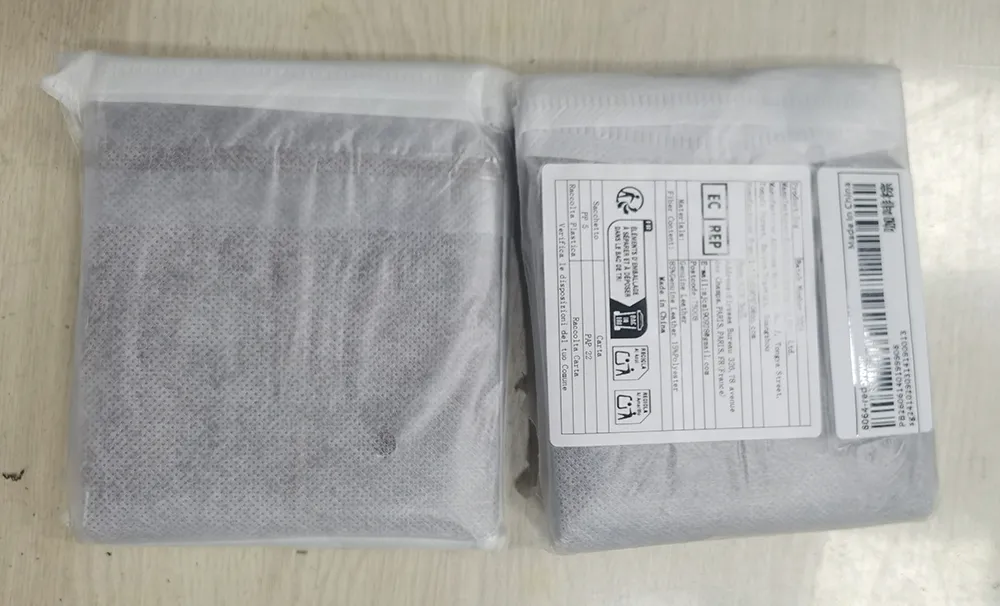
| Internal risk analysis and risk controls | Manufacturer contact details on product, packaging, parcel or accompanying document (Art. 9(5), 16(3)) | Supplier declarations |
| Standards or assessment methods used, where relevant | Instructions and safety information where required (Art. 9(7)) | Listing screenshots |
| Test reports where applicable | EU responsible economic operator details (Art. 16) | Document revision history |
| Kept 10 years and produced to authorities on request (Art. 9(2)) | Complaint, recall and corrective-action register (Art. 9(12)); Article 19 online listing requirements | Tanning-batch linkage and retrieval procedure |
A product identifier is mandatory under Article 9(5). Linking that identifier to a specific leather or tanning batch, and retrieving the records within 24 hours, goes beyond the minimum rule — but provides far stronger commercial traceability when a marketplace or customer comes asking.
Who Is the Manufacturer in a Private Label Project?
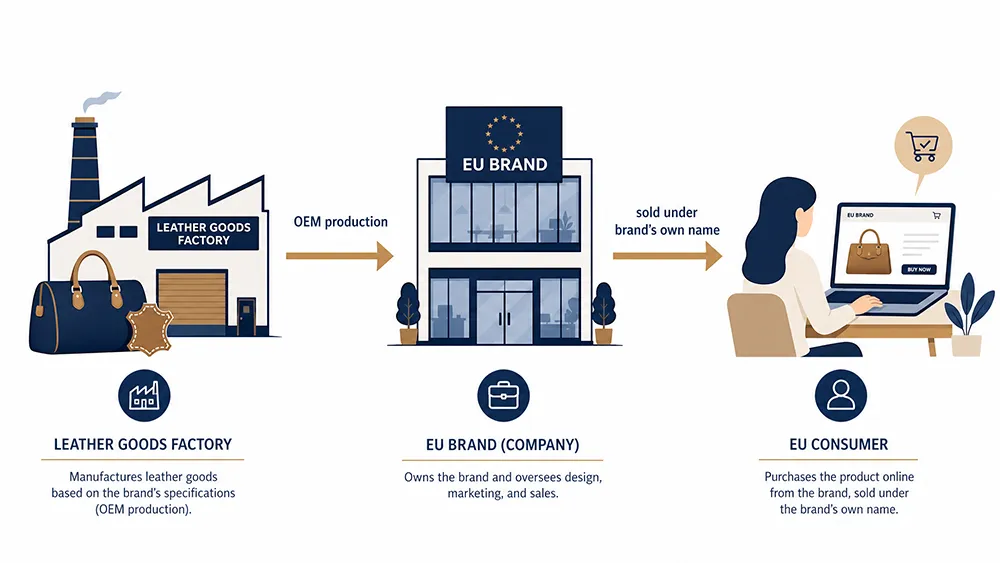
The question most OEM discussions skip — and the one that matters most. Under Article 13, any person who places a product on the market under their own name or trademark is deemed a manufacturer and takes on the full Article 9 obligations. So in a typical custom OEM arrangement, the EU brand is often the legal manufacturer. The factory supplies materials data, hardware test reports and batch records — but it can’t sign away the brand’s responsibility, and it shouldn’t try to.
The EU Responsible Person: Who Actually Holds the Role?
A non-EU brand doesn’t necessarily need to “purchase an EU Responsible Person service.” The responsible EU-established economic operator may be the EU manufacturer, the importer, an authorised representative acting under a written mandate, or — where none of those parties is established in the EU — a fulfilment service provider handling the product. That’s the order the law implies (Regulation (EU) 2019/1020, Article 4); jumping straight to a paid representative without checking whether your importer already qualifies is money spent twice.
What Article 19 Online Listing Requirements Demand
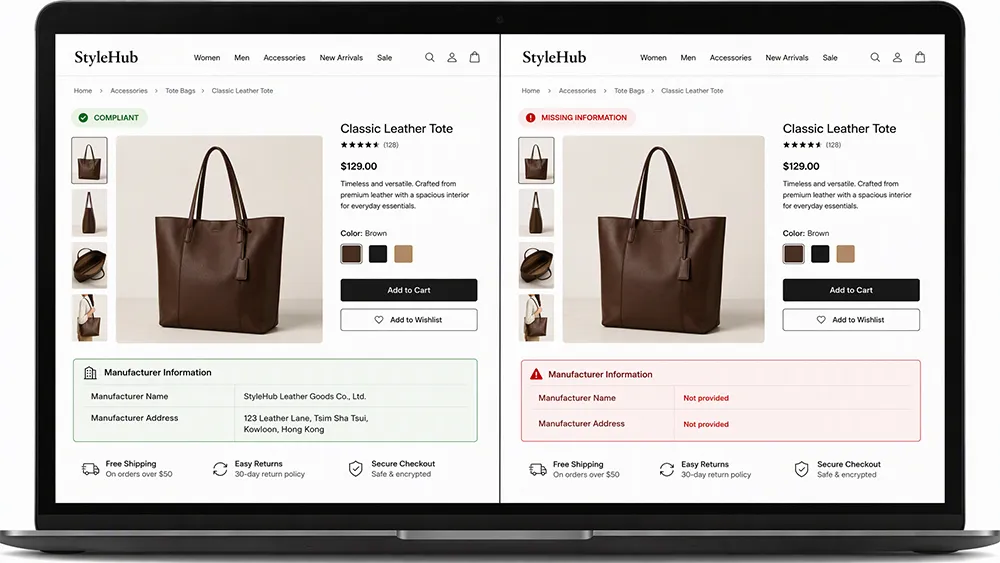
For distance sales to EU consumers, the offer page itself — not a PDF attached to an email — must show:
- The manufacturer’s name, registered trade name or trademark, plus postal and electronic address
- Where the manufacturer is not established in the EU, the responsible person’s name, postal and electronic address
- Information allowing the product to be identified, including a picture, its type and any other relevant product identifier
- Warnings and safety information in a language easily understood by consumers in the destination country
German, French and Polish for those three markets. English alone doesn’t cut it.
What happens when something’s missing? Enforcement varies by platform, authority and Member State. A marketplace may restrict an offer, customs may suspend release, and national authorities may request information or impose corrective measures.
GPSR itself does not establish a single EU-wide fine amount or a guaranteed warning-first sequence — platforms like Amazon and Temu each run their own processes, and sellers report everything from quiet delistings to formal information requests. Assume any compliance notice deserves a fast answer. The commercial damage of a blocked listing usually arrives before any legal penalty does — but Article 44 leaves fines to national law, and they are not trivial where they do land.
A Scenario Worth Thinking Through
Consider a hypothetical EU brand that receives a marketplace compliance request but cannot connect its product identifier to production records. Sales may remain restricted while the brand reconstructs the documentation and updates its listings. Now flip it: the same request arrives, and the brand answers within a day with batch records, supplier declarations and a matching listing page. Which supplier do you think gets the next purchase order? Documentation isn’t just defense. It’s a sales asset.
Your GPSR Checklist
- Article 9 core documentation: description, risk analysis, standards/methods, test reports
- Documentation kept 10 years and retrievable on request
- Product identifier on the product — or, where size or nature doesn’t allow, on packaging or an accompanying document
- Manufacturer name and postal + electronic address marked (product, packaging, parcel or accompanying document)
- Instructions and safety information where required, in destination-country languages
- EU responsible economic operator identified (importer / authorised representative / fulfilment provider, per the hierarchy above)
- Article 19 details displayed on every online offer page
- Complaint, recall and corrective-action register in place
- Listing information consistent with the physical label (best practice)
For the broader export picture — REACH, labeling, shipping documents — our earlier guide covers it: Genuine Leather Bag Export Compliance. For more factory-side notes, browse the Marrant blog.
Frequently Asked Questions
Q1: Does GPSR apply if I only sell small volumes or custom orders?
There is no general small-volume exemption. A commercial offer targeted at EU consumers can fall within scope even when only one unit is sold. The relevant question is when the particular product was first placed on the EU market, not how long the model has existed. Products lawfully placed on the market before 13 December 2024 remain covered by the transitional provision.
Q2: My bags have no CE mark. Is that a problem?
An ordinary non-electronic leather bag generally does not require CE marking. However, bags incorporating regulated electronic, radio, protective or toy-related features may fall under additional legislation. GPSR also does not replace applicable chemical rules such as REACH.
Q3: Will I get fined right away if my listing is missing the responsible person’s details?
Not necessarily, but no warning-first sequence is guaranteed. Platforms and national authorities apply different procedures, and Article 44 leaves penalties to national law. Treat any information request or remediation deadline as urgent.
Conclusion
GPSR for leather bags rewards the prepared. Build the Article 9 core file, keep traceability you can actually retrieve, work out who the legal manufacturer and responsible person are before the PO is signed, and mirror the Article 19 details on every offer page. Do that, and the regulation stops being a threat and becomes a moat — because plenty of competitors still treat a PDF attached to an email as a compliance strategy.
This article is for general information only and does not constitute legal advice. Regulatory requirements change; please verify against the current official GPSR text and consult qualified counsel for your specific situation.