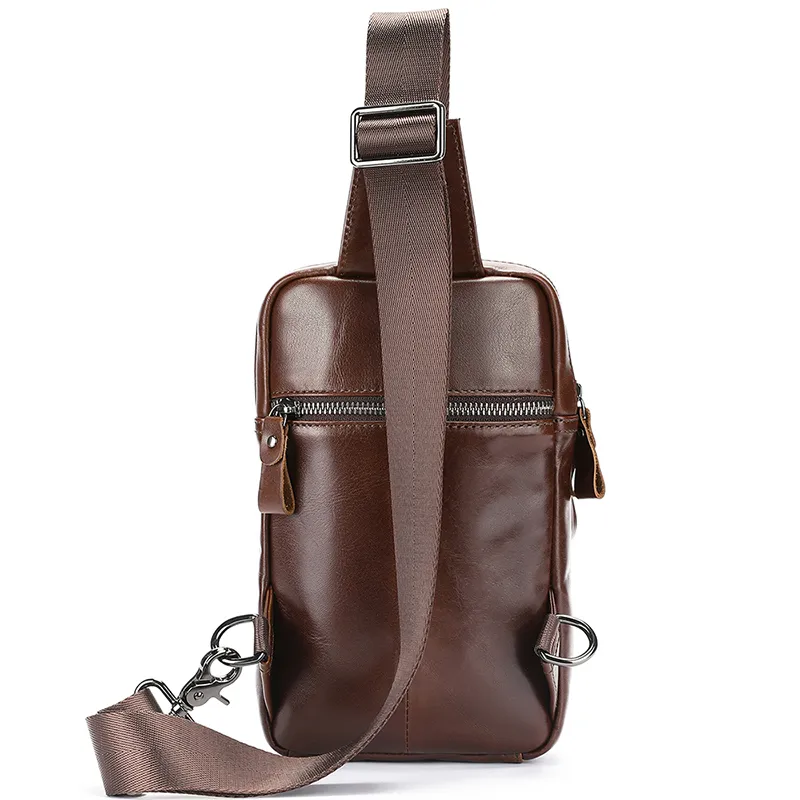
For some sling bags, switching shoulders is easy: with a centred strap and reinforced D-rings at both lower corners, the wearer moves the detachable clip to the other side.
For a left shoulder vs right Shoulder sling bags, the work depends on the original construction. Moving the clip does not require separate left- and right-shoulder bodies; check the zipper and pockets both ways.
Define Left and Right from the Wearer’s View
Left and right shoulders are defined from the wearer’s view; left on a front-view drawing becomes right when worn. The technical pack needs a back view, a strap connection drawing and an on-body photo, not a note to “move the strap to the other side.

Right-handedness does not decide the shoulder. Handedness, the chosen shoulder and the rotation to the front are different. A left shoulder vs right shoulder sling bag decision needs a clear answer from the wearer’s side.
What Changes in Production?
Production work depends on the base structure. A built-in switchable design has a centred upper strap, two reinforced lower D-rings and a detachable snap hook; moving the clip changes neither the pattern nor the body count. A fixed or asymmetrical design with one lower anchor, a directional pad or a one-way zipper may need the anchor, zipper or pocket adjusted.
| Production area | Fixed-side design | Built-in switchable design |
|---|---|---|
| Pattern | Non-symmetrical parts may need mirrored panels | The same body pattern can support both sides when the switchable system is built into the design |
| Upper strap | May sit off-centre or carry a directional pad | Centred for two-way use |
| Lower anchor | Usually one fixed connection | A D-ring or loop each side |
| Strap hardware | Can be fixed | Detachable clip or swivel hook |
| Zipper and pockets | May suit one rotation | Check both wearing directions |
| Reinforcement | Reinforce the main anchor | Reinforce both lower anchors |
| User switching | Requires a separate version for the other side | Move the clip to the other side |
| Sample check | Check the fixed side | Try both wearing states |
Pattern Making and Leather Cutting
Curved and fitted structures may need the anchor tab, back pad, side panels or shoulder pad mirrored. For another sling bag product format, see our Sling Bags 7589. In a custom crossbody bag project, shoulder orientation may affect the anchor, zipper and pocket layout.
Once you mirror a pattern, the layout can change; leather’s shape, grain, colour and usable area affect cutting. Every part must face the correct direction after assembly.
Strap Anchors, Hardware and Reinforcement
Some sling bags use one upper strap connection and two lower D-rings. The wearer clips the free end to either corner, so no two bodies are needed for left and right.
A detachable snap hook lets the strap move between D-rings; a swivel hook can rotate and may prevent twisting. The adjustment buckle should not press on the shoulder, collarbone or back after the clip moves. Either lower tab can become the active load point, so both sides need the same reinforcement. For a related product format, see our Everyday Sling Bag 9000.
Do not guess at load figures; agree on the strap-load test and acceptance before sampling.
Zipper Direction and Pocket Access
The rotation to the chest can change with the wearing shoulder. A single-pull zipper is easy from one direction but may sit far from the hand on the other.
A double pull helps both directions but not every issue. Check the phone, anti-theft back, card and strap pockets.
Fixed Orientation or Ambidextrous Design?
You can choose a fixed or ambidextrous design. For bulk sling bags with a built-in switchable strap, one product covers both directions; separate SKUs matter only when the buyer orders distinct fixed-left and fixed-right versions or different labelling.
For photography, cycling and outdoor uses, think about the reaching hand, the stabilizer strap and the movement. For brands developing wholesale sling bags, confirm the wearing direction before sampling.

What Buyers Should Check on the Sample
Check these on the sample:
- Left/right marked from the wearer’s view
- Strap attached correctly, not twisted
- Shoulder pad sits naturally; buckle clears the body
- Zipper opens easily when rotated to the front
- Phone and back pockets easy to reach
- Anchors reinforced; labels correct
- Both wearing states tried
If the anchor, shoulder pad, zipper, pocket or pattern changed, confirm the revised sample. Before approving a customised sling bag, test how it sits, rotates and opens in the intended position. Our leather bag sample approval checklist turns these points into a form you can send the factory.
What to Confirm Before Production
When sourcing sling bags bulk, orientation notes in the leather bag OEM specification sheet help the factory keep versions apart. Before you settle on a left shoulder vs right shoulder sling bag, confirm these points:
- Is left/right defined from the user’s view?
- Fixed-direction or built-in switchable?
- Which way will the user rotate the bag?
- Which anchors need reinforcement?
- Which wearing states must be tested?
Frequently Asked Questions
Q1. Does a right-handed customer always need a left-shoulder sling bag?
Not necessarily. Handedness, the chosen shoulder and the rotation to the front are different. A right-handed user may carry it on either side; a try-on with target users is the most reliable check.
Q2. Can one sling bag be designed for both shoulders?
Yes. Connection points on both sides, a detachable strap, a swivel buckle, double zipper pulls or a two-way pocket layout all work. Test both wearing states.
Q3. Does changing the shoulder side require a new sample?
Not necessarily. A built-in switchable design does not need a separate left- or right-side sample, but the development sample should be tested in both wearing states. If the strap, pad, zipper, pocket or pattern changes, confirm the revised sample.
Tell us about your sling bag project and we will quote it against your pattern. Send a sketch or reference style, the target wearing direction, the strap structure, your quantity and your logo requirements.
Conclusion
If a sling bag has two lower attachment points, changing shoulders may be no more than moving one clip. If the strap, padding, zipper or pockets are fixed to one side, the wearing direction becomes a production specification. State the structure in the technical pack, and test the sample in every carry position.